
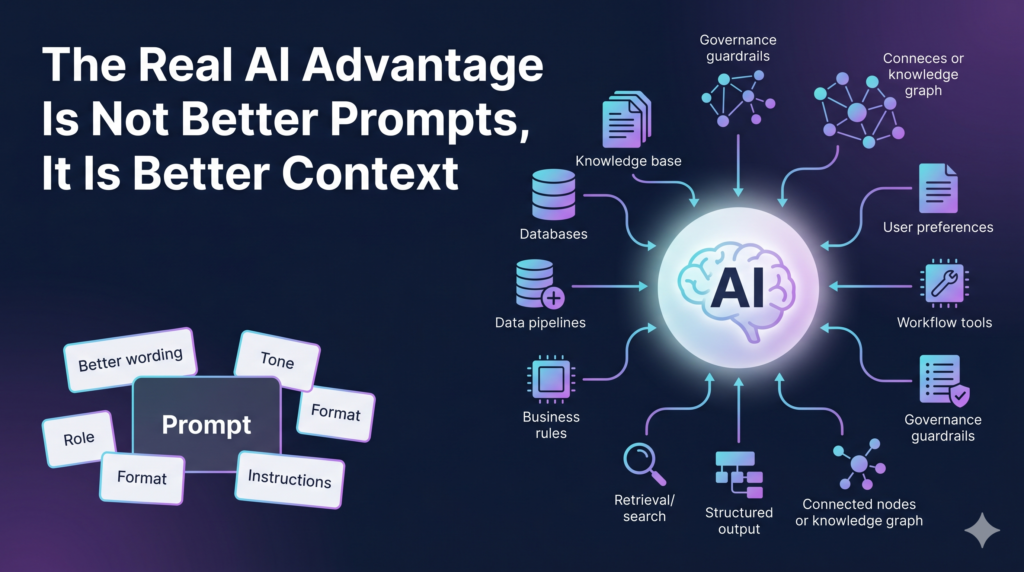
The Real AI Problem Starts Before The Prompt
A product manager opens ChatGPT on a Monday morning.
She has a simple task. She needs to prepare a weekly business update for leadership. She writes a clear prompt:
“Create a weekly business update for our product team. Include user growth, churn, revenue movement, risks, and next steps.”
The AI responds quickly. The language is polished. The structure is neat. The tone is professional.
But something feels wrong.
The update sounds like it could belong to any company. It does not mention last week’s delayed release. It does not understand why churn increased in one customer segment. It does not know that leadership prefers short updates. It does not remember that the team already decided to pause one feature. It does not know the real story behind the numbers.
So she improves the prompt.
She adds more detail. She adds tone. She adds formatting rules. She asks for an executive style. She asks for sharper recommendations. The answer becomes better, but still not deeply useful.
The issue is not the wording of the prompt.
The issue is that the AI has not been given the world in which the answer must live.
That is the real shift happening in AI today. The advantage is no longer about writing the perfect prompt. The advantage is about giving AI the right context.
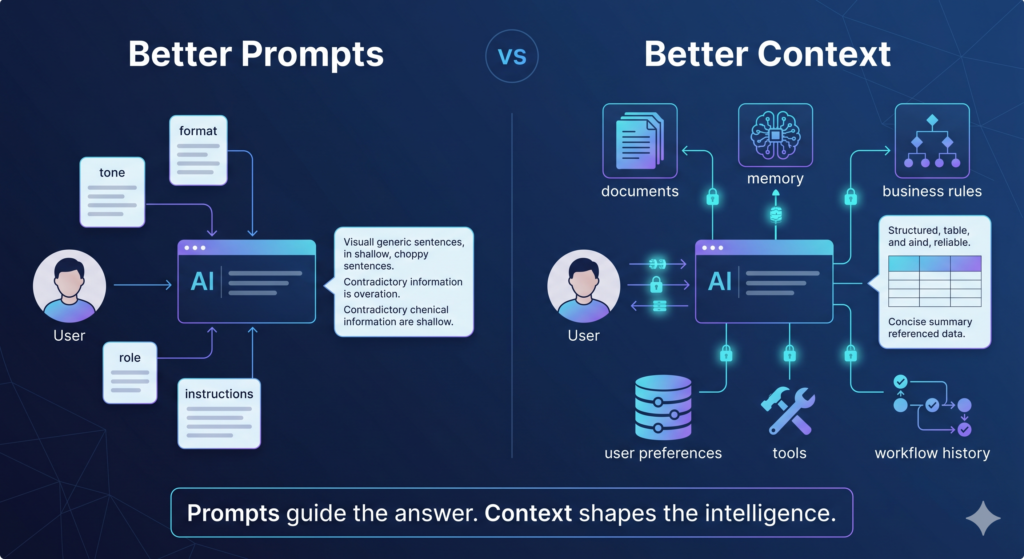
Better Prompts Help, But They Do Not Solve Everything
Prompt engineering became popular because it solved a real problem.
If you ask a vague question, you usually get a vague answer. If you give clear instructions, examples, audience details, output format, and tone, the answer improves.
This is useful.
A weak prompt says:
“Write a summary.”
A stronger prompt says:
“Write a 500-word summary for senior business leaders. Use simple language. Focus on revenue impact, operational risk, and three recommended actions.”
The second prompt is clearly better. It gives the AI direction. It reduces guesswork. It improves the output.
But there is a ceiling.
A prompt can tell the AI what kind of answer you want. It cannot automatically give the AI your company history, current priorities, internal documents, customer data, past decisions, business rules, technical constraints, and user preferences.
That missing information is where most AI failures begin.
When AI gives a generic response, people often blame the prompt. In many cases, the prompt is not the real problem. The AI simply does not know enough about the task, the environment, or the decision being made.
Prompt engineering improves communication with AI.
Context engineering improves the AI’s ability to understand the situation.
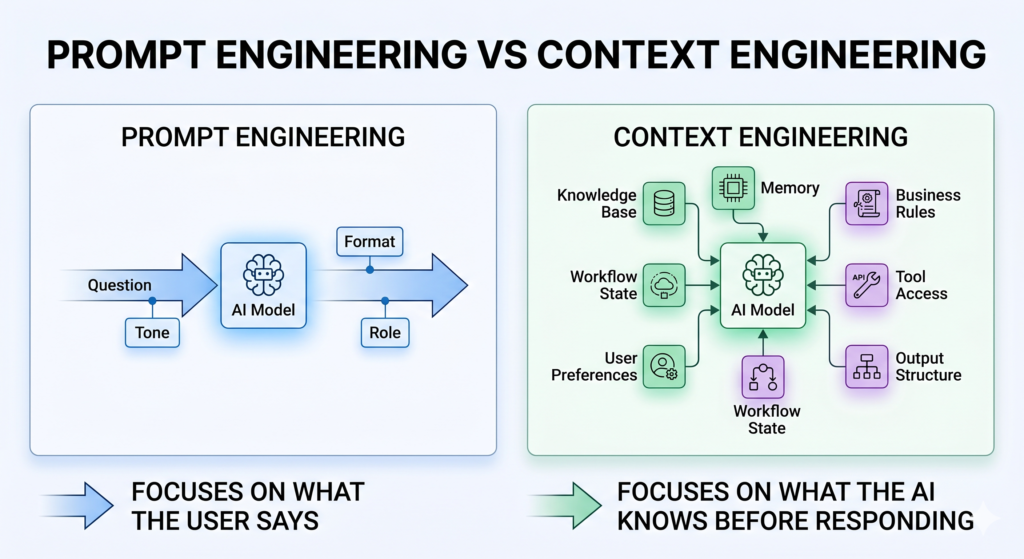
Context Engineering Creates The Working Environment
Context engineering is the practice of designing the information environment around an AI model.
It includes the instructions, documents, memory, business rules, user preferences, tools, workflows, data sources, and output expectations that shape how AI responds.
A prompt is one message.
Context is the full operating environment.
Think of a pilot flying a plane.
A great pilot needs skill, but skill alone is not enough. The pilot also needs the flight plan, weather data, fuel status, aircraft condition, air traffic instructions, destination details, runway information, and emergency procedures.
Without that context, even a skilled pilot is forced to guess.
AI works in a similar way.
The model may be powerful, but if it does not have the right context, it can only produce a general answer. It may sound confident, but it is still working with limited situational awareness.
Context engineering gives AI that situational awareness.
It helps the model understand what matters, what has already happened, what source should be trusted, what rules should be followed, and what output will be useful.
The Best AI Systems Are Not Just Chat Windows
Most people first experience generative AI as a chat window. They type a question and get a response.
That makes AI feel like a conversation tool.
But serious AI adoption is moving beyond chat. Businesses are building AI assistants, AI copilots, AI agents, document intelligence systems, analytics assistants, and workflow automation tools.
These systems cannot depend only on clever prompts.
A customer support AI needs access to product guides, ticket history, refund rules, customer plans, and escalation policies.
A data analytics AI needs access to metric definitions, table schemas, data lineage, quality rules, and dashboard logic.
An insurance AI needs to understand submissions, risks, quotes, documents, carriers, brokers, versions, and compliance rules.
A legal AI needs contract templates, approved clauses, jurisdiction rules, review history, and risk categories.
In each case, the quality of the AI output depends on the quality of the surrounding context.
The model matters. The prompt matters. But the system around the model often matters more.
Context Engineering Has Clear Building Blocks
Context engineering may sound abstract, but it can be broken into simple building blocks.
The first building block is a role.
The AI must know what it is supposed to be. Is it acting as a business analyst, a data architect, a compliance reviewer, a research assistant, or a customer support agent? Each role changes how the AI should think and respond.
The second building block is instruction.
The AI needs rules. These rules may include tone, format, boundaries, safety limits, approval steps, and preferred reasoning style.
The third building block is knowledge.
This includes documents, policies, manuals, data dictionaries, previous reports, product information, and technical designs. AI becomes much more useful when it can use trusted knowledge instead of relying only on general training.
The fourth building block is memory.
Memory helps AI carry important information across a task or workflow. It may include user preferences, previous decisions, project status, rejected options, or recurring formats.
The fifth building block is tool access.
Modern AI systems often need to call tools. They may search documents, query databases, read calendars, check emails, create tickets, run code, or update systems. Tool results become live context.
The sixth building block is output structure.
A good AI system knows what success should look like. Sometimes the answer should be a paragraph. Sometimes it should be a table, JSON object, checklist, architecture note, executive summary, or action plan.
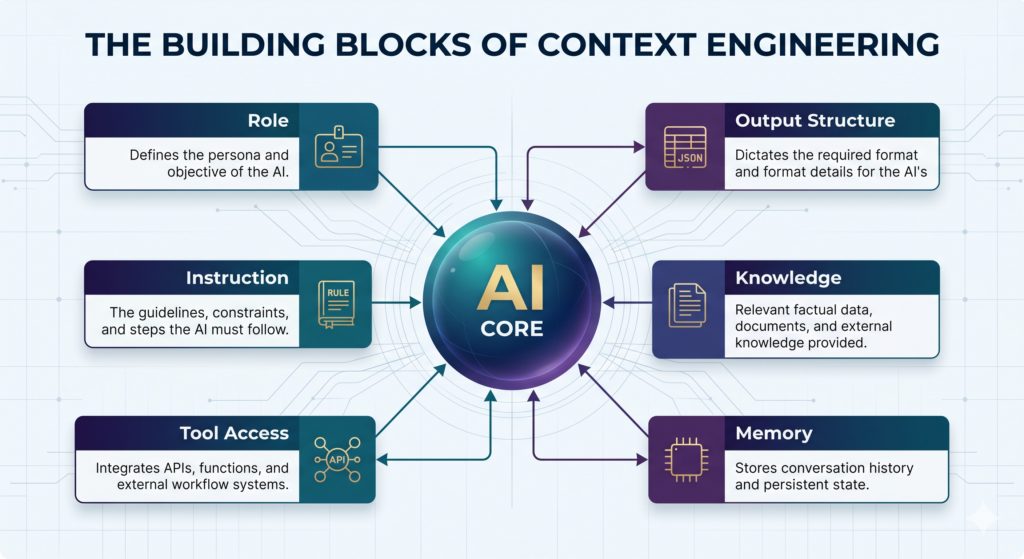
When these building blocks work together, AI becomes less random and more reliable.
RAG Makes Context Engineering Practical
One of the most important patterns in context engineering is RAG, which stands for Retrieval-Augmented Generation.
The idea is simple.
Before AI answers a question, the system searches a trusted knowledge source. It retrieves the most relevant pieces of information and gives them to the model as context. The model then uses that retrieved information to generate a better answer.
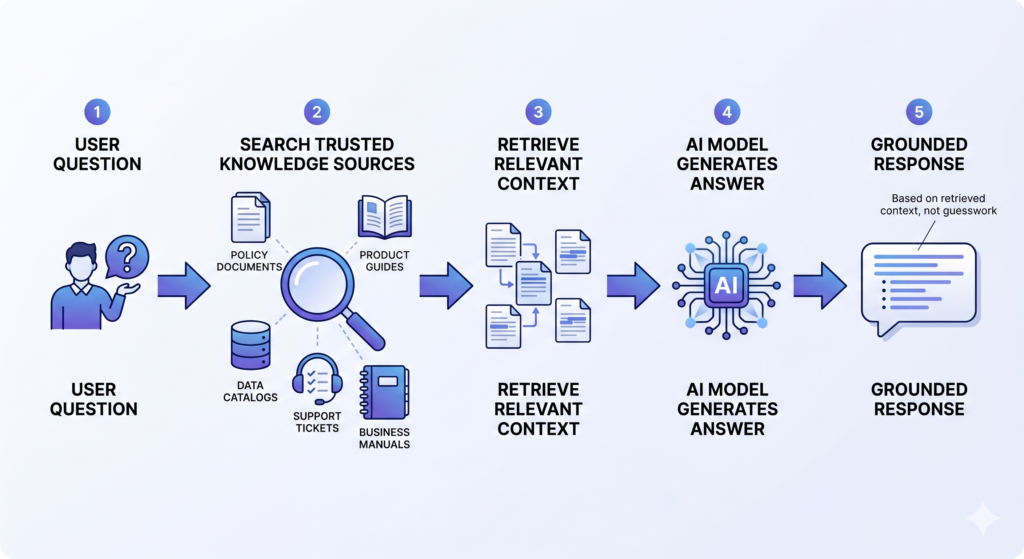
This is powerful because AI does not need to guess from memory.
For example, imagine an employee asks the following:
“What is our policy for enterprise customer refunds?”
Without RAG, the AI may provide a general answer based on common refund practices.
With RAG, the system can search the company’s actual refund policy, retrieve the correct section, and guide the AI to answer from that source.
This reduces hallucination. It improves trust. It makes the response more specific.
But RAG is not magic by itself.
The documents must be clean. The chunks must be meaningful. The search must retrieve the right content. The AI must know how to handle conflicts. Old documents must not override new ones. Sensitive documents must be protected.
That is why RAG is not just a technical feature. It is a context design discipline.
Better Context Changes The Same AI Model
The power of context becomes clear when you compare two versions of the same task.
Imagine a marketing leader asks AI to create a campaign brief.
In the prompt-only version, the leader provides a product name, target audience, and expected format. The AI creates a decent campaign brief. It includes goals, channels, messaging, and success metrics.
It looks good, but it is still generic.
In the context-engineered version, the AI already has access to previous campaign results, customer personas, brand voice, competitor positioning, budget limits, approved claims, product roadmaps, and performance benchmarks.
Now the answer changes.
The campaign brief uses proven messaging. It avoids claims that legal had rejected before. It recommends channels based on past conversion. It adjusts the tone to match the brand. It highlights the audience segment with the highest buying intent.
The AI model is the same.
The difference is the context.
This is why context engineering creates an advantage. It turns AI from a general assistant into a specialized system.
Enterprises Need Governed Context
In personal use, a wrong AI answer may be annoying.
In business use, a wrong AI answer can be expensive.
That is why enterprises cannot treat context casually.
They need governed context.
Governed context means the AI uses approved sources, follows access rules, respects privacy, cites information when needed, and avoids using outdated or unauthorized content.
This is especially important in areas like finance, healthcare, insurance, law, data platforms, and regulated industries.
An enterprise AI system should know which documents are official, which data fields are sensitive, which users can access which information, and which outputs require human review.
This is where data governance and AI governance meet.
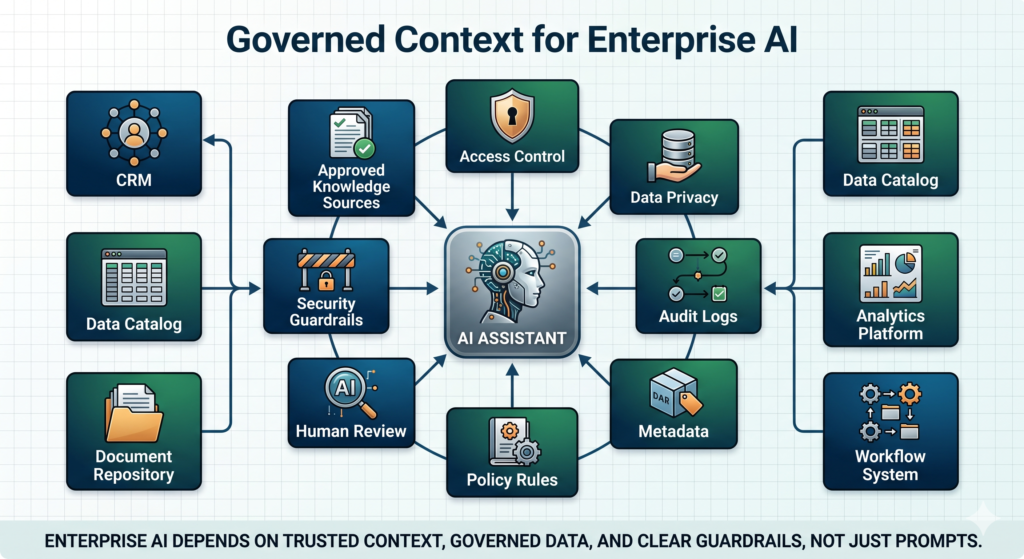
The future of enterprise AI will not be shaped only by larger models. It will be shaped by better context pipelines, stronger metadata, trusted knowledge bases, cleaner data products, and well-designed control layers.
In simple words, enterprises do not just need AI.
They need AI with the right context and the right guardrails.
More Context Is Not Always Better Context
Many people assume that if AI has a larger context window, the problem is solved.
That is not true.
A large context window allows the model to process more information at once, but more information can also create more confusion.
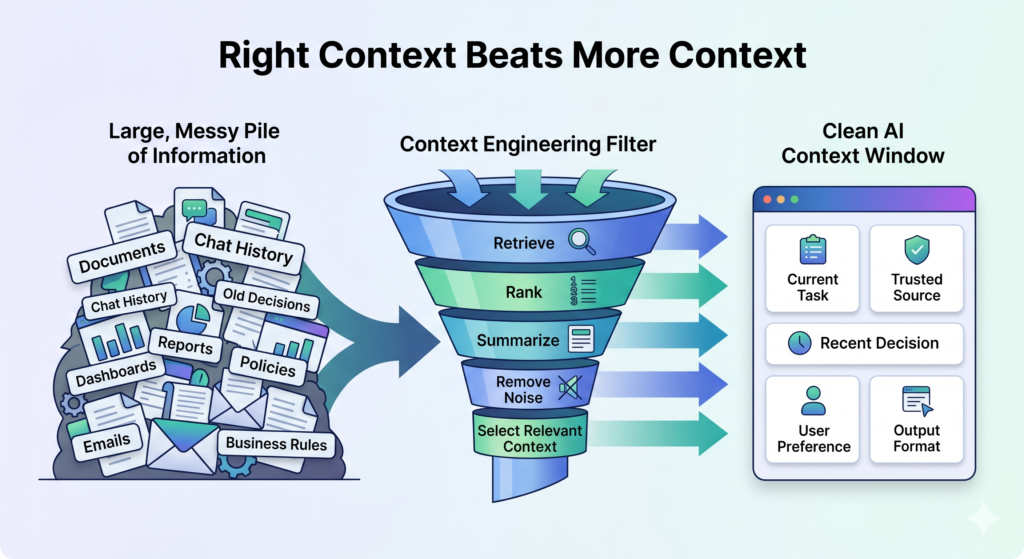
If you give the AI ten documents, five old decisions, three conflicting policies, and a long chat history, the model may struggle to identify what matters most.
Good context engineering is not about throwing everything into the model.
It is about selecting the right information for the task.
The best AI systems filter context. They rank it. They summarize it. They remove noise. They keep what is relevant and ignore what is not.
This is similar to preparing a briefing note for a senior executive. You do not send every document in the company. You send the right facts, the right risks, the right decisions, and the right recommendation.
AI needs the same discipline.
A clean context window often beats a crowded one.
Context Assets Compound Over Time
A prompt is often temporary. You write it, use it, and move on.
A context asset can grow.
A context asset may be a curated knowledge base, a reusable system instruction, a business glossary, a set of approved examples, a memory profile, a retrieval pipeline, or an output template.
These assets improve with use.
You can refine them. You can add better examples. You can remove outdated content. You can improve document quality. You can tune retrieval. You can update business rules. You can standardize output formats.
Over time, the AI system becomes more useful because the context becomes more mature.
This is why context engineering creates long-term value.
Better prompts may give better answers today.
Better context creates a better AI capability for the future.
The Human Role Becomes More Strategic
Context engineering does not remove humans from the process. It makes human judgment more important.
Humans decide which sources are trusted. Humans define business rules. Humans understand exceptions. Humans know the difference between a technically correct answer and a useful business answer.
AI can process information quickly, but humans must decide what information deserves to be in the system.
This creates a new kind of skill.
The valuable AI professional of the future will not only know how to write prompts. They will know how to design the context around AI. They will understand data, workflows, governance, user needs, and business outcomes.
They will ask better design questions.
What should the AI know before answering? Which source should it trust? What should it remember? What should it forget? What should it never access? What format will make the answer actionable?
These questions are more powerful than prompt tricks.
The Future Belongs To Context-First AI Thinkers
The real AI advantage is not better prompts. It is a better context.
Prompts are still useful. They help us communicate with AI. They give direction. They shape the response.
But context gives AI understanding.
Context tells AI where it is, who it is helping, what data matters, what rules apply, what happened before, and what success looks like.
That is the difference between a nice answer and a reliable system.
As AI becomes part of business workflows, software products, data platforms, and decision-making processes, context engineering will become one of the most important skills in the AI world.
The winners will not be the people with the longest list of saved prompts.
The winners will be the people who know how to build the right environment around AI.
They will give AI the right knowledge, memory, tools, structure, and guardrails.
They will stop asking AI to guess.
They will help AI understand.
And that is where the real advantage begins.
For more such data-oriented blogs, please visit: https://manasjain.com/data-archi-talks-blogs/