
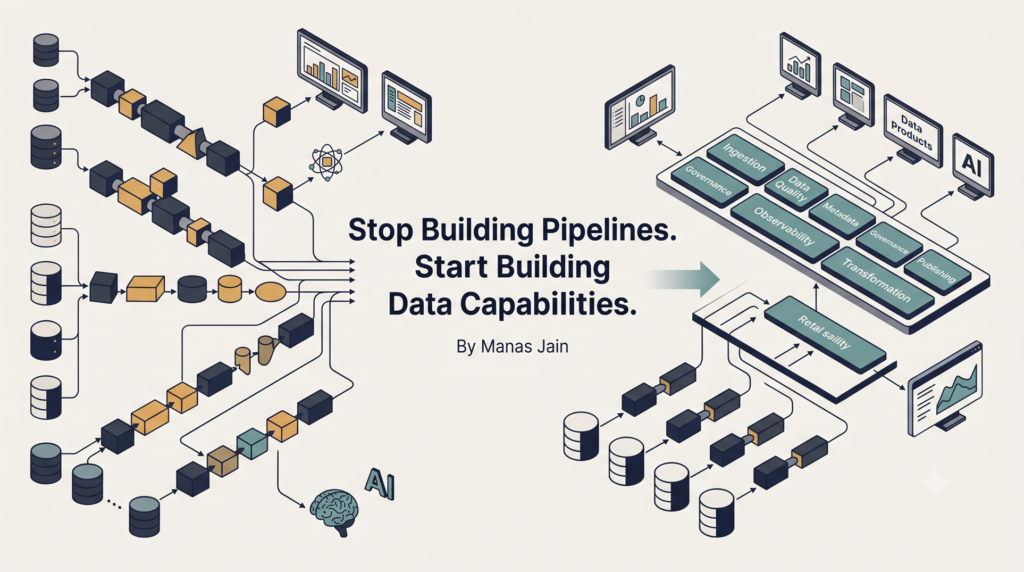
A business team asks for a new customer dashboard.
The data team identifies the source systems, builds ingestion jobs, creates transformation logic, adds data-quality checks, configures access, sets up monitoring, and deploys the final dataset.
A few months later, another team asks for similar customer data for a machine learning use case.
The process starts again.
A new ingestion flow is created. Similar transformations are rewritten. Quality rules are copied into another repository. Monitoring is configured separately. Security requirements are interpreted again.
Both pipelines may work.
The problem is that the organization has built two solutions to the same underlying problem.
This pattern is common in data teams. Delivery is organized around individual pipelines, projects, and use cases. Each request is treated as a fresh implementation, even when much of the required functionality already exists elsewhere.
Over time, the organization does not just accumulate pipelines. It accumulates duplicated logic, inconsistent controls, different interpretations of the same business rules, and a growing operational burden.
The answer is not to stop building pipelines.
The answer is to stop treating every pipeline as a completely independent piece of architecture.
Data teams need to move from repeatedly building pipelines to developing reusable data capabilities.
The pipeline factory problem
Pipelines are necessary. They move data, apply transformations, and deliver information to downstream consumers.
But a pipeline is a delivery mechanism. It is not, by itself, an architectural strategy.
When delivery is centered entirely on pipelines, the team often ends up rebuilding the same foundations:
- connecting to common source systems;
- validating schemas;
- handling failed records;
- applying standard data-quality rules;
- capturing metadata;
- configuring access controls;
- monitoring freshness and volume;
- publishing data to analytics or operational systems.
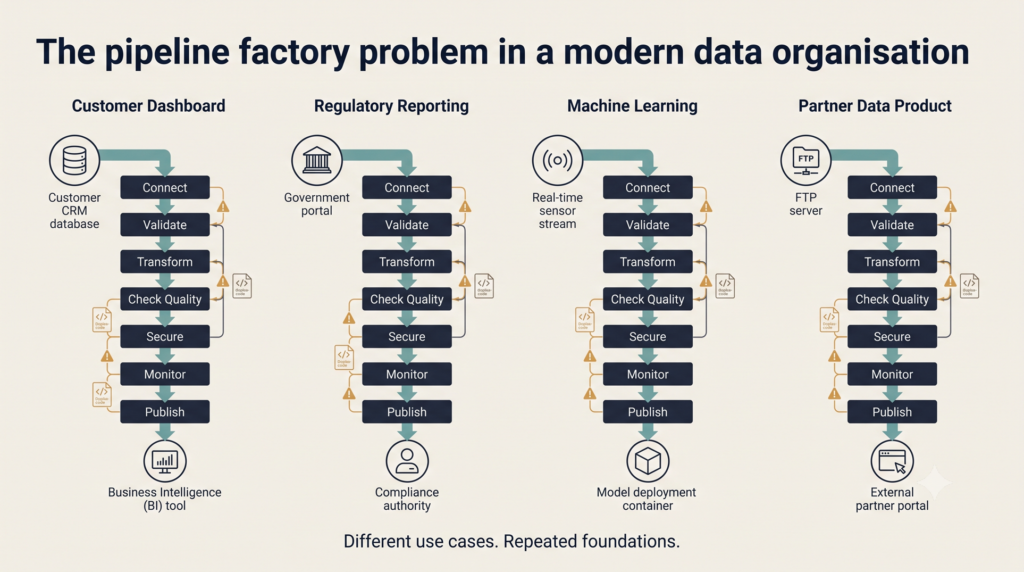
The names of the datasets may change, but the work is often remarkably similar.
This creates what can be described as a pipeline factory.
The factory is busy. New workflows are constantly being delivered. Yet each delivery adds more code, more configuration, and more operational responsibility.
At first, this approach can feel fast. A team can build a custom pipeline without waiting for shared standards or platform capabilities.
The cost appears later.
A source-system change breaks several pipelines in different ways. A security policy must be implemented separately across dozens of workflows. Similar customer calculations produce different results because each team interpreted the rules differently. Monitoring behaves differently from one pipeline to another.
The organization becomes good at creating pipelines but increasingly poor at managing the data estate those pipelines create.
Start by identifying repeated work
The first step towards reusable capabilities is not a large platform program.
It is a simple inventory exercise.
Take five to ten recently delivered pipelines and examine how they were built.
Look beyond the business-specific transformation logic. Identify the tasks that appear repeatedly.
For example:
| Pipeline activity | Repeated implementation |
|---|---|
| Source onboarding | Credentials, connectivity, schema discovery and extraction logic |
| Validation | Mandatory field checks, schema validation and duplicate detection |
| Transformation | Standardisation, reference-data mapping and business calculations |
| Data quality | Rule execution, threshold management and failed-record handling |
| Metadata | Ownership, descriptions, lineage and classification |
| Security | Access groups, masking, encryption and audit logging |
| Monitoring | Freshness, volume, failures and processing duration |
| Publishing | Tables, APIs, files, events or semantic models |
This exercise usually reveals that only part of each pipeline is genuinely unique.
The business logic may be specific to the use case. The supporting functions often are not.
A useful rule is:
If the same type of logic has been implemented three times, it should be reviewed as a candidate for a reusable capability.
This does not mean every repeated function needs to become a new platform service. Some may be handled through shared libraries, templates, configuration, or common engineering standards.
The important change is to stop accepting duplication as the default.
What is a data capability?
A data capability is a reusable function that helps teams solve a recurring data problem in a consistent way.
A capability may be implemented through:
- a shared service;
- a software library;
- a configuration-driven framework;
- a deployment template;
- an API;
- a standard data contract;
- a managed platform feature;
- a documented engineering pattern.
For example, “customer data ingestion” is usually too narrow to be a reusable capability.
“Batch file ingestion with schema validation, quarantine handling, metadata capture, and monitoring” is much more reusable.
It describes a standard way of solving a recurring problem without tying the solution to one particular dataset.
The capability should make the preferred approach easier than building a custom solution.
That is an important test.
If teams need to raise several tickets, wait for a central team, and work through complex governance steps to use the capability, they will often create their own alternative.
Reusable architecture succeeds when it reduces delivery effort, not when it simply adds another layer of control.
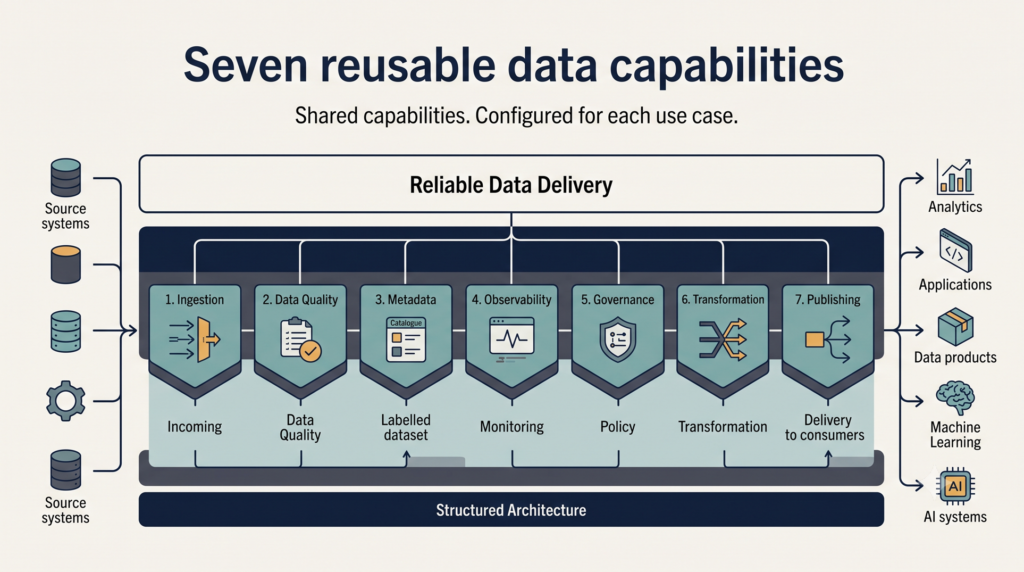
Seven capabilities worth standardising
Most organizations do not need to standardize everything at once. They should start with areas where duplication, risk, or operational effort is highest.
Seven capabilities usually provide a strong foundation.
1. Source onboarding and ingestion
Connecting to a source should not require every team to rediscover the same technical and operational requirements.
A reusable ingestion capability can provide the following:
- approved connectivity patterns;
- credential and secret management;
- batch, streaming and change-data-capture options;
- schema discovery;
- restart and recovery handling;
- standard audit fields;
- metadata capture;
- source-level monitoring;
- configurable scheduling.
The objective is not to force every source through one ingestion technology.
The objective is to provide consistent behavior.
For example, every ingestion process should answer the same questions:
- When was the data last received?
- How many records were processed?
- Did the schema change?
- Were any records rejected?
- Can the process restart safely?
- Who owns the source?
- What downstream datasets are affected by a failure?
A team onboarding a new source should configure these behaviors rather than building each one from scratch.
Practical action
Review your last five source integrations.
List the code and configuration that was repeated across them. Separate source-specific logic from common operational logic.
The common elements form the initial scope of your ingestion capability.
2. Data-quality execution
Data-quality checks are often embedded directly inside transformation pipelines.
This creates several problems.
Rules are difficult to discover. Similar checks are implemented differently. Failed records are handled inconsistently. Business teams cannot easily see which rules are being applied.
A reusable data-quality capability should allow teams to define rules separately from pipeline code wherever possible.
It should support:
- schema checks;
- completeness rules;
- uniqueness checks;
- reference-data validation;
- business-rule validation;
- threshold-based checks;
- failed-record quarantine;
- quality scorecards;
- rule ownership;
- issue escalation.
Consider a rule such as the following:
Every active customer record must have a valid country code.
That rule should not exist as an undocumented line of code inside one customer pipeline. It should be visible, owned, measurable, and reusable across every relevant customer dataset.
Practical action
Select one high-value dataset and extract its quality rules into a simple rule catalog.
For each rule, capture:
- rule description;
- business owner;
- technical implementation;
- severity;
- acceptable threshold;
- action when the rule fails;
- datasets where the rule applies.
This catalogue can be created before investing in a sophisticated data-quality platform.
3. Metadata and ownership
Many data problems are not caused by missing data.
They are caused by missing context.
Teams do not know what a field means, who owns a dataset, whether it contains sensitive information, or which downstream processes depend on it.
Metadata should not be added after delivery as a documentation exercise. It should be captured as part of the delivery process.
A reusable metadata capability should make it easy to record the following:
- dataset name and description;
- business domain;
- owner and steward;
- source systems;
- refresh frequency;
- sensitivity classification;
- business definitions;
- schema;
- lineage;
- quality status;
- retention requirements.
The capability does not need to begin with an enterprise-wide catalogue implementation.
It can start with standard metadata requirements embedded into delivery templates and deployment checks.
For example, a dataset should not move into production unless an owner, description, classification, and refresh expectation have been provided.
Practical action
Define the minimum metadata required for every production dataset.
Keep the initial list short enough that teams will actually maintain it. Six well-maintained metadata fields are more useful than thirty empty ones.
4. Observability
A pipeline finishing successfully does not necessarily mean the data is usable.
The process may have loaded half the expected records. The source may have stopped sending updates. A field may have changed format. A downstream table may be stale.
Technical job monitoring is not enough.
A reusable observability capability should monitor the behavior of the data as well as the execution of the pipeline.
At a minimum, teams should be able to monitor:
- freshness;
- record volume;
- processing duration;
- schema changes;
- null-rate changes;
- failed quality rules;
- rejected records;
- downstream impact;
- service-level objectives.
The goal is to detect issues before consumers report them.
Practical action
Choose one critical data flow and define three operational indicators:
- How fresh should the data be?
- What record-volume range is considered normal?
- Which quality failures should trigger an alert?
Start with these indicators before creating a large observability program.
5. Governance and policy enforcement
Governance often becomes a series of manual approvals added to the end of delivery.
This slows teams down without reliably reducing risk.
Reusable governance capabilities embed policies into the engineering workflow.
Examples include:
- automatic sensitivity classification;
- standard access-control patterns;
- policy-based masking;
- encryption requirements;
- retention rules;
- audit logging;
- approval workflows for restricted data;
- automated checks in deployment pipelines.
The objective is not to remove human judgement. It is to stop using human effort for routine controls that can be implemented consistently.
A developer should not need to interpret the organization’s masking policy every time a new dataset containing email addresses is created.
The approved behavior should already be available as a reusable pattern.
Practical action
Identify one governance policy that is currently implemented manually across multiple projects.
Convert it into a repeatable technical control, template, or deployment check.
Start with a policy that is common and clearly understood, such as mandatory encryption, restricted-data access, or production dataset ownership.
6. Transformation and business-rule reuse
Not every transformation should be centralized.
Domain teams need the freedom to implement business logic close to the people who understand it.
However, repeated definitions should not be allowed to spread unchecked.
Common calculations such as customer status, policy status, product hierarchy, revenue allocation, or geographic mapping are often recreated in several pipelines.
The result is inconsistent reporting and endless reconciliation.
A reusable transformation capability can include:
- common reference-data services;
- shared transformation libraries;
- versioned business-rule modules;
- reusable models;
- tested calculation components;
- semantic definitions;
- standard transformation templates.
The key is to separate reusable business definitions from use-case-specific processing.
For example, a team may need a unique marketing segmentation model. But it should not create its own definition of an active customer if an approved definition already exists.
Practical action
Ask analysts and engineers which metrics or business definitions cause the most reconciliation discussions.
Choose one definition and create a governed, versioned implementation that multiple teams can reuse.
Do not start by attempting to standardize the entire enterprise vocabulary.
7. Data consumption and publishing
A dataset is not complete simply because it exists in a warehouse or lakehouse.
Consumers need a reliable way to access and understand it.
Different use cases may require different interfaces:
- analytical tables;
- semantic models;
- APIs;
- event streams;
- extracts;
- feature tables;
- vector-ready documents;
- governed data products.
The capability should standardize how data is published, not insist on a single consumption format.
A good publishing capability defines the following:
- interface expectations;
- versioning rules;
- service levels;
- access mechanisms;
- documentation requirements;
- change-notification processes;
- support responsibilities.
This becomes especially important when data is consumed by AI systems.
A model or retrieval system needs more than access to a file or table. It needs stable structures, clear meaning, quality controls, traceable sources, and predictable update behavior.
Reusable publishing patterns make data easier to consume across analytics, operational, and AI use cases.
Practical action
Review the datasets most frequently used by other teams.
For each one, identify whether consumers have:
- a clear access method;
- documentation;
- an owner;
- an update frequency;
- quality information;
- advance notice of breaking changes.
Where these are missing, the organization does not yet have a reliable consumption capability.
Standardise the outcome, not every tool
One of the biggest mistakes in capability-led architecture is turning standardization into forced uniformity.
A global organization may use different technologies across business units. Some use batch processing, while others depend on streaming. One domain may publish analytical tables, while another exposes operational APIs.
Trying to force every team onto the same implementation can create resistance and slow delivery.
Instead, standardize the outcomes and interfaces.
For ingestion, the standard may require:
- auditable processing;
- schema-change detection;
- recovery handling;
- metadata capture;
- operational monitoring.
The implementation may vary depending on the platform and use case.
For data quality, the standard may require:
- named rules;
- ownership;
- severity;
- thresholds;
- measurable results;
- defined failure handling.
Different tools may execute those rules, but the outcome remains consistent.
This approach creates governed flexibility.
Teams retain room to make appropriate implementation choices, while the organization maintains control over the characteristics that matter.
Use contracts to connect capabilities
Reusable capabilities work best when they are joined through clear contracts.
A contract makes expectations explicit.
It defines what one part of the data ecosystem provides and what another part can rely on.
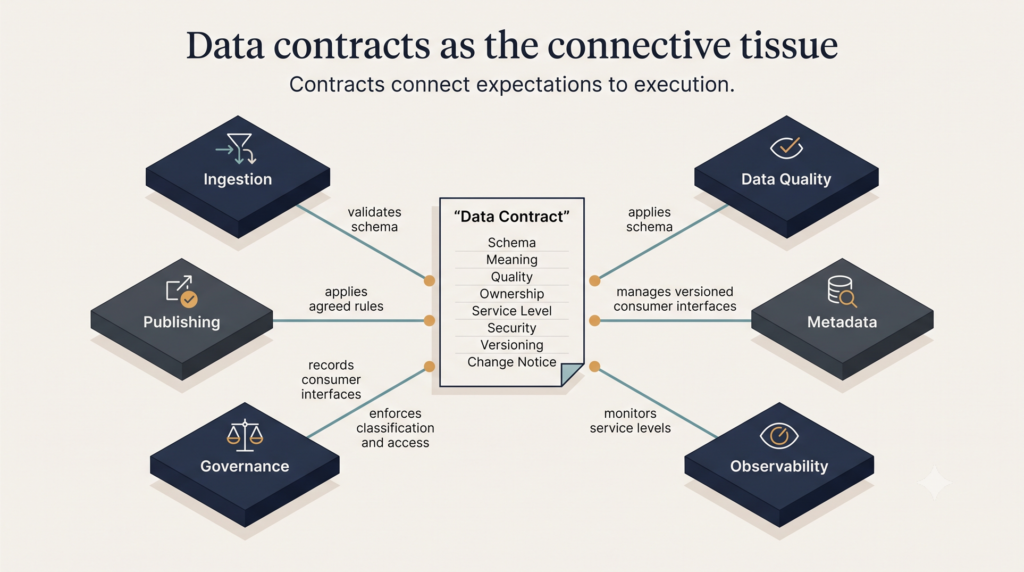
A practical data contract may include:
- schema and field definitions;
- mandatory and optional attributes;
- business meaning;
- data-quality expectations;
- update frequency;
- service-level objectives;
- ownership;
- security classification;
- versioning;
- change-notification requirements;
- support arrangements.
Contracts prevent capabilities from becoming loosely connected platform features.
For example, an ingestion capability can validate an incoming schema against the contract. The quality capability can execute the agreed rules. The metadata capability can register ownership and definitions. The observability capability can monitor freshness against the agreed service level.
The contract connects these activities around a shared set of expectations.
Without this connection, teams may build several reusable tools but still lack a consistent delivery model.
Avoid creating a central platform bottleneck
There is a real risk that a capability-led approach becomes another centralisation programme.
A platform team builds reusable services. Every domain must request access. Changes enter a backlog. Teams wait weeks for support. Eventually, they begin creating workarounds.
The architecture may be reusable in theory but unusable in practice.
To avoid this, capabilities should be designed as paved roads.
A paved road provides the default path, standard controls, and reusable components. Teams can use it without waiting for the platform team to perform every action.
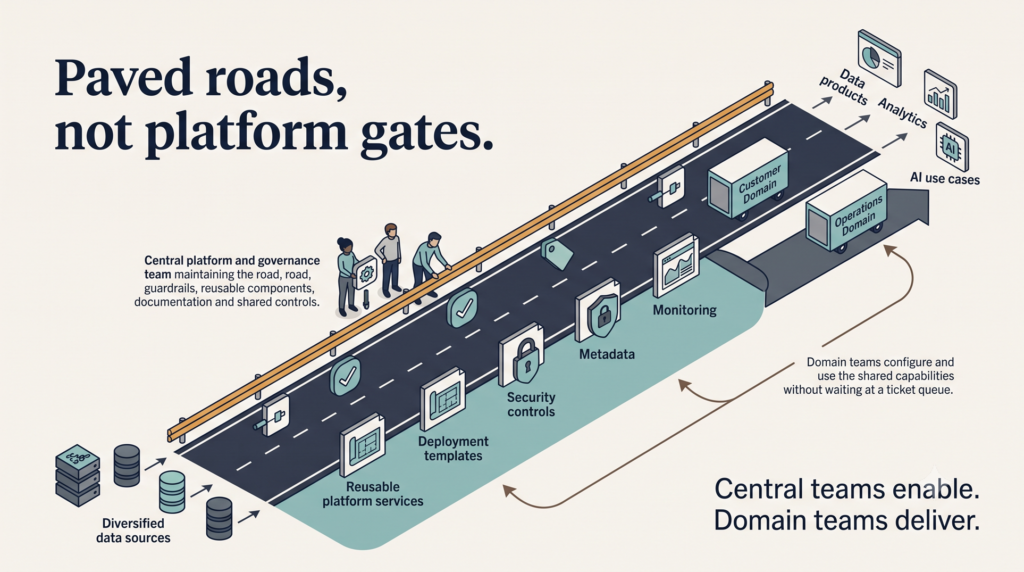
A practical operating model usually includes:
Central teams
Central platform, architecture, or governance teams should:
- define common interfaces;
- provide shared tooling;
- implement organisation-wide controls;
- publish templates and examples;
- maintain core platform services;
- support contribution standards.
Domain teams
Domain teams should:
- configure capabilities for their use cases;
- own domain-specific business rules;
- maintain their data products;
- contribute improvements;
- provide feedback on missing functionality;
- manage exceptions transparently.
Joint responsibilities
Both groups should work together on:
- prioritising capability improvements;
- reviewing repeated local solutions;
- managing exceptions;
- measuring adoption;
- retiring duplicated implementations.
The central team should not need to build every pipeline.
Its role is to make good delivery practices repeatable.
Build one capability through real use cases
Do not begin with a multi-year capability map covering every aspect of the data platform.
Start with one repeated problem.
A practical sequence is the following:
- Select a capability with visible duplication or operational pain.
- Choose two or three real use cases that need it.
- Identify what is common across those use cases.
- Define the standard interface and expected outcomes.
- Build the minimum reusable implementation.
- Use it in the selected use cases.
- Measure effort, issues, and adoption.
- Improve it based on delivery feedback.
The capability should be developed through real delivery, not in isolation.
For example, suppose three teams need to ingest partner files.
Instead of building three separate ingestion pipelines, define a configurable file-ingestion capability that handles:
- file arrival detection;
- naming validation;
- schema validation;
- duplicate-file detection;
- failed-record quarantine;
- metadata capture;
- processing audits;
- monitoring;
- retry handling.
Each team can then configure the source location, schema, and processing rules.
The organization still delivers three pipelines, but it does not build the same operational foundation three times.
Measure whether reuse is actually happening
A capability is not successful because it has been launched.
It is successful when teams use it and delivery improves.
Track measures that show both adoption and impact.
Useful indicators include:
- percentage of new pipelines using standard patterns;
- time required to onboard a new source;
- time required to add a new quality rule;
- number of duplicated integrations;
- number of custom monitoring implementations;
- percentage of production datasets with defined ownership;
- number of recurring incidents caused by inconsistent logic;
- reuse of common business definitions;
- time required to identify downstream impact;
- number of policy exceptions;
- consumer satisfaction with published datasets.
Avoid measuring only the number of capabilities created.
A large capability catalog with low adoption is not progress.
It may simply be another layer of unused architecture.
A 30–60–90-day action plan
Moving towards reusable capabilities does not require a major reorganization.
It requires a focused first step.
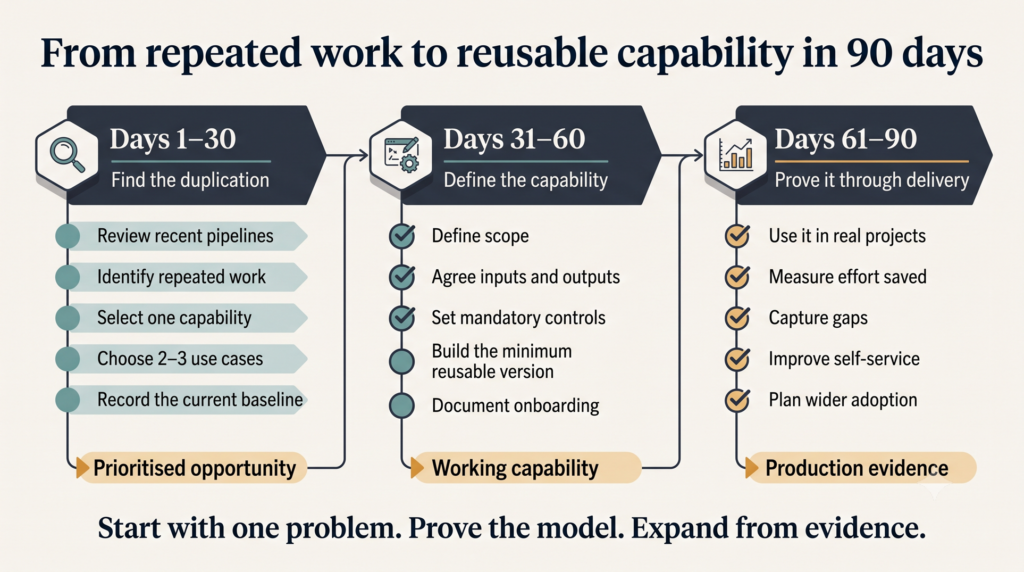
Days 1–30: Find the duplication
Review a representative sample of recent pipelines.
Document:
- repeated ingestion logic;
- repeated quality checks;
- duplicated business rules;
- common monitoring requirements;
- recurring governance activities;
- frequently reused datasets;
- operational issues caused by inconsistency.
Identify the capability with the strongest combination of:
- repeated effort;
- delivery delay;
- operational risk;
- broad demand;
- achievable scope.
Do not choose a capability simply because it is technically interesting.
Choose one that solves a visible delivery problem.
Output after 30 days
You should have:
- a list of repeated implementation patterns;
- a prioritised capability opportunity;
- two or three use cases for the first implementation;
- a baseline measure of current effort or pain.
Days 31–60: Define the capability
Work with the teams delivering the selected use cases.
Define:
- what the capability will do;
- what it will not do;
- required inputs;
- expected outputs;
- configuration options;
- mandatory controls;
- ownership;
- support model;
- success measures.
Keep the first implementation small.
Do not try to support every possible scenario.
For example, an ingestion capability may initially support scheduled CSV and JSON files rather than every database, API and streaming source.
Output after 60 days
You should have:
- a capability definition;
- a standard interface;
- an initial implementation;
- onboarding documentation;
- agreed measures of success.
Days 61–90: Prove it through delivery
Use the capability in the selected real-world use cases.
Track:
- engineering time saved;
- defects;
- onboarding effort;
- custom work still required;
- operational consistency;
- user feedback;
- capability gaps.
Refine the implementation based on evidence.
Then decide whether to:
- expand the supported scenarios;
- improve self-service;
- migrate existing pipelines;
- add automated controls;
- develop the next capability.
Output after 90 days
You should have:
- a capability proven in production;
- measurable delivery results;
- documented gaps;
- an adoption plan;
- evidence for further investment.
Questions data leaders should ask
Data leaders do not need to review every line of pipeline code.
They do need to challenge the delivery model.
Ask:
- How much of this solution already exists elsewhere?
- Which parts of the implementation are genuinely use case specific?
- Are we creating another local version of a common business rule?
- Can another team reuse what we are building?
- Does the preferred approach make delivery faster?
- Are governance and monitoring built into the pattern?
- Who owns this capability after launch?
- How will we measure adoption?
- What will stop teams from creating their own alternative?
- Which duplicated implementation can we retire?
These questions shift the conversation from project delivery to organizational capability.
The practical takeaway
The problem is not that organizations have too many pipelines.
The problem is that too many pipelines are built as if nothing reusable already exists.
A capability-led approach does not eliminate pipelines, domain ownership, or implementation flexibility.
It creates a stronger foundation for all three.
The most effective starting point is not a new architecture diagram or a long platform roadmap.
It is a review of repeated work.
Find one problem that several teams are solving independently. Define the outcome that should be consistent. Build the smallest reusable capability that makes the next delivery easier.
Then prove it through real use cases.
Key takeaways
- Pipelines are delivery mechanisms, not the complete architecture.
The architecture should also define the reusable capabilities that pipelines consume. - Start with repeated work.
Review recent pipelines and identify the functions being rebuilt across teams. - Standardize outcomes and interfaces.
Do not force every team to use the same implementation when different technologies are appropriate. - Build capabilities through real delivery.
Select two or three use cases and develop the reusable solution alongside them. - Make the preferred path the easiest path.
Capabilities that require lengthy central-team involvement will be bypassed. - Connect capabilities through contracts.
Schemas, quality expectations, ownership, service levels, and versioning should be explicit. - Measure adoption and delivery improvement.
A capability only creates value when teams use it and it reduces effort, risk, or inconsistency. - Start small and prove the model.
One useful production capability is more valuable than a large theoretical capability map.
The next stage of data architecture is not about building more pipelines.
It is about creating reusable capabilities that make every future pipeline easier to build, govern, and operate.