
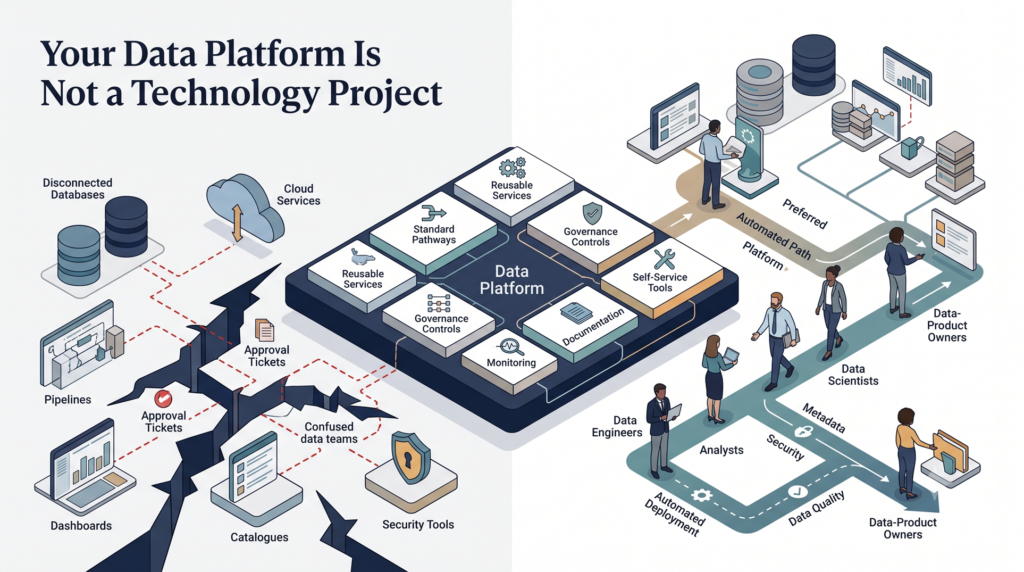
Many organizations have modernized their data stack without modernizing the way they deliver data.
They have moved workloads to the cloud, introduced new integration tools, implemented lakehouses, adopted catalogs, and invested in analytics platforms. Yet business teams still wait weeks for access. Data engineers still spend much of their time resolving one-off requests. Analysts still build around platform limitations. Governance teams still enter the process late. New projects still repeat the same setup work.
The technology may be modern, but the operating model is not.
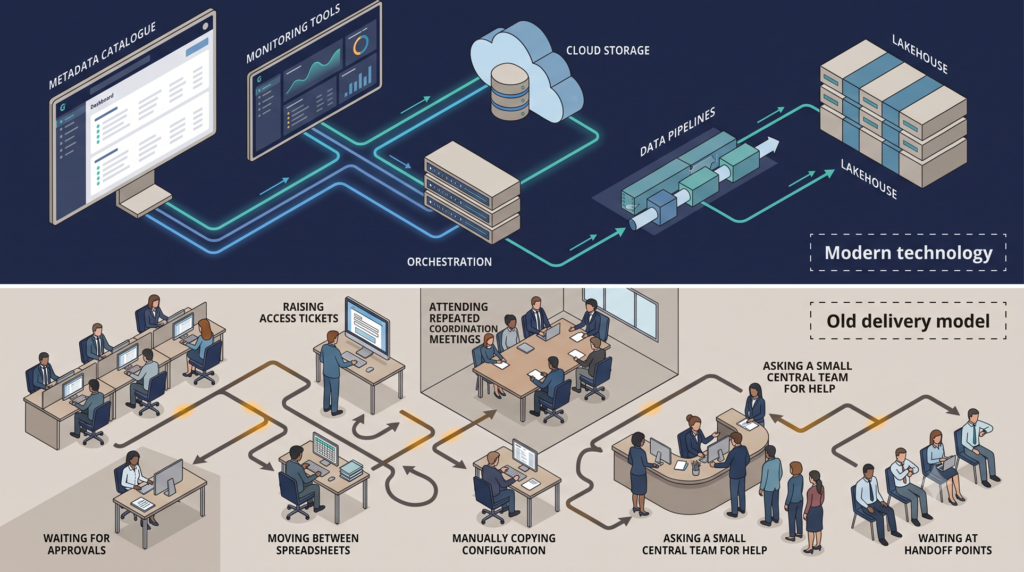
This is the mistake data leaders need to address.
A data platform is not successful because it contains the latest tools. It is successful when teams can use it to deliver trusted data products quickly, safely, and repeatedly.
That requires more than architecture.
It requires product thinking, clear ownership, standard delivery paths, embedded governance, usable documentation, and ongoing attention to the experience of the people using the platform.
In other words, your data platform is not a technology project. It is an organizational capability.
The real test of a data platform
The real test of a platform is not whether it has been deployed.
The test is whether teams can use it without depending on a small group of experts for every decision.
Ask a new data product team to begin work on your platform.
How long does it take them to:
- Receive the right access?
- Find the relevant data?
- Create a development environment?
- Deploy a pipeline?
- Publish a dataset?
- Apply data-quality rules?
- Register ownership and metadata?
- Move from development to production?
- Understand who supports them when something fails?
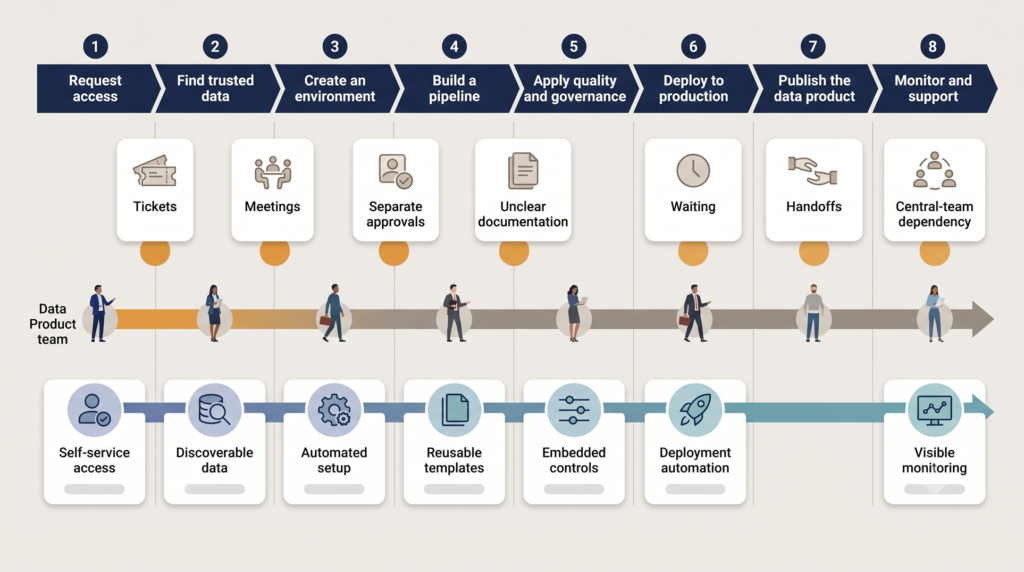
If each step requires a meeting, a ticket, a spreadsheet, a separate approval, and several conversations with the central platform team, you do not yet have self-service.
You have centralized dependency supported by modern technology.
This distinction matters because many platform programs report success too early. The infrastructure is available, the tools are integrated, and the architecture has been approved. But the experience of delivering on the platform remains slow and difficult.
Platform success should be measured through the work it enables, not the technology it installs.
Start with the users, not the tools
Before approving another platform capability, identify who the platform is intended to serve.
A typical data platform may support:
- data engineers building pipelines;
- analysts creating reporting and semantic models;
- data scientists preparing features and experiments;
- application teams consuming operational data;
- data-product owners managing domain datasets;
- governance teams applying standards and controls;
- support teams monitoring production workloads.
These users do not need the same experience.
A data engineer may need reusable deployment templates, observability, and automated environment setup.
An analyst may need discoverable, well-documented datasets with clear business definitions.
A data product owner may need usage information, quality metrics, ownership workflows, and service expectations.
A governance team may need evidence that controls are being applied consistently without manually reviewing every implementation.
If the platform roadmap is based only on technical components, these user needs are easily missed.
A more useful approach is to write down the main jobs each user needs to complete.
For example:
As a data engineer, I need to deploy a standard ingestion pipeline without creating infrastructure from scratch.
As an analyst, I need to find trusted customer data and understand how it should be used.
As a data product owner, I need to know whether my product is reliable, discoverable, and being adopted.
These statements may look simple, but they force the platform team to focus on outcomes rather than components.
“Implement a metadata catalogue” is a technology activity.
“Help analysts find trusted data in under ten minutes” is a platform outcome.
“Introduce infrastructure as code” is a technical capability.
“Enable a delivery team to create a compliant development environment in one hour” is a platform outcome.
The difference changes the conversation.
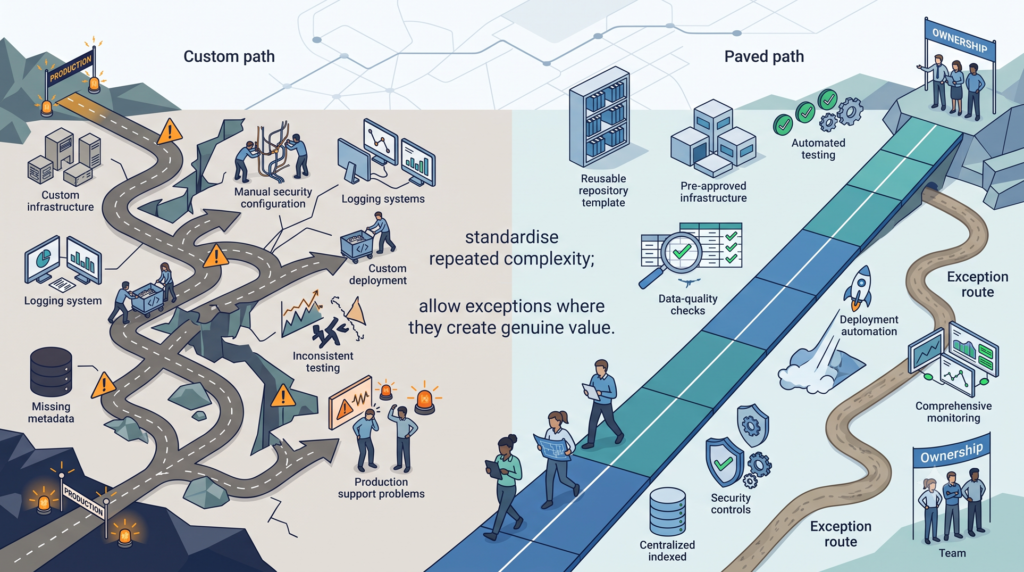
Build paved paths for common work
Most organizations do not need unlimited flexibility for every data workload.
They need a small number of well-designed paths for the work teams to perform repeatedly.
These are often called paved paths or golden paths. The terminology matters less than the principle: make the preferred way of working easy to discover, easy to use, and easier than building a custom alternative.
A paved path might include the following:
- a standard repository structure;
- pre-approved infrastructure templates;
- deployment pipelines;
- logging and monitoring;
- data-quality checks;
- metadata registration;
- security controls;
- naming standards;
- production-readiness criteria;
- support and ownership information.
Consider a common requirement such as ingesting data from a source system.
Without a paved path, every team may make separate decisions about orchestration, secrets, error handling, schemas, retries, logging, testing, metadata, and alerting.
The organization then ends up with ten technically valid solutions that are difficult to operate consistently.
With a paved path, the team starts from a reusable template. The platform provides the default controls and operational patterns. The delivery team focuses on the source-specific logic.
This does not mean every workload must be identical.
It means the organization should standardize the parts that do not create a competitive advantage.
Teams rarely create business value by inventing another logging framework, another deployment process, or another way to store pipeline configuration.
The platform team should absorb this repeated complexity.
A practical starting point
Choose three activities that occur frequently and currently create unnecessary delays.
For example:
- creating a new data pipeline;
- publishing a curated dataset;
- requesting access to sensitive data.
For each activity, document the current steps, approvals, systems, and handovers.
Then ask:
- Which steps can be automated?
- Which decisions can be converted into defaults?
- Which controls can be embedded in templates?
- Which approvals are genuinely required?
- Which steps exist only because systems are poorly integrated?
- Where do teams repeatedly ask for help?
Do not begin by designing the perfect enterprise platform.
Begin by removing friction from work that teams already perform.
Treat onboarding as a platform capability
Onboarding is one of the clearest indicators of platform maturity.
In many organizations, onboarding is informal. A new team receives links to several documents, attends a few meetings, and relies on experienced colleagues to explain how things really work.
This creates a hidden dependency on organizational memory.
A usable platform should provide a clear onboarding path that answers five questions:
- What can I do on the platform?
- What is the standard way to do it?
- What access do I need?
- What controls must I follow?
- Where do I go when I am blocked?
The onboarding experience should include a small working example.
A new team should be able to create a simple pipeline, deploy it, publish an output, register its metadata, and view its operational status.
This is more useful than a long architecture presentation.
People understand platforms by using them.
Measure onboarding properly
Track how long it takes a capable team to move from initial request to its first successful production deployment.
Break that time into the following:
- waiting for access;
- waiting for environments;
- waiting for approvals;
- implementation time;
- testing time;
- rework caused by unclear standards;
- production-readiness checks.
This will show whether the real constraint is technology, process, documentation, ownership, or governance.
Without this breakdown, platform teams often optimize the wrong thing.
They improve deployment speed while teams are still waiting ten days for access.
Embed governance into delivery
Governance becomes a source of friction when it is applied as a separate review process after a solution has already been designed.
By that point, changing the implementation is expensive. Delivery teams feel blocked, governance teams feel ignored, and both groups become frustrated.
A better platform approach is to convert governance policies into reusable controls.
For example:
- mandatory ownership fields in product templates;
- automated classification of sensitive data;
- access rules based on approved roles;
- default encryption and retention settings;
- schema checks in deployment pipelines;
- quality thresholds before publishing;
- lineage capture as part of normal execution;
- policy checks before production release.
The objective is not to eliminate governance oversight.
The objective is to reduce the number of situations that require manual interpretation.
Governance specialists should focus on areas that genuinely need judgement. Standard cases should be handled through platform defaults.
This leads to an important design principle:
The compliant path should also be the easiest path.
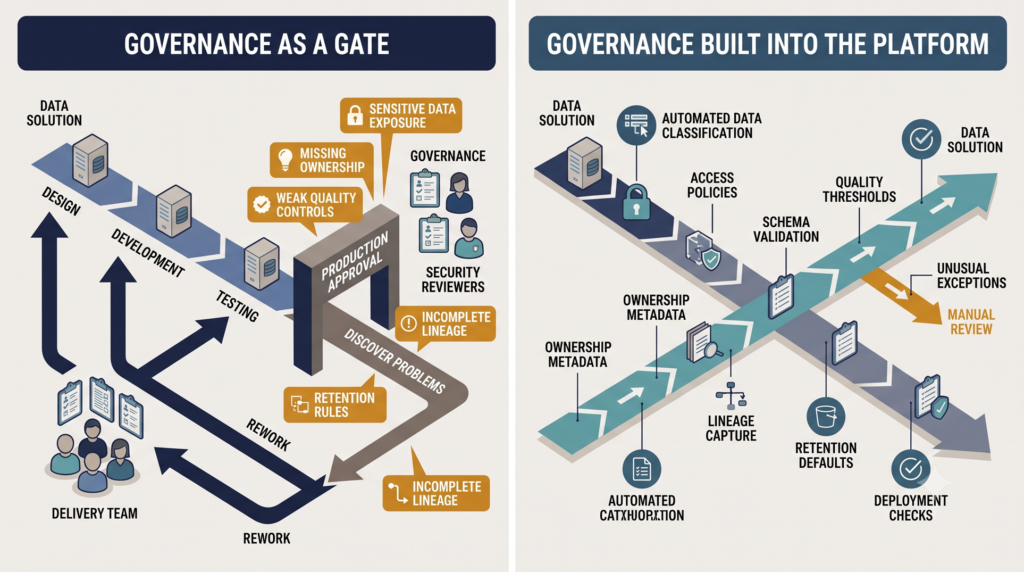
If teams must bypass the platform to meet a deadline, the platform has failed.
If they need expert knowledge to apply basic controls, the controls have not been operationalized.
If every use case requires a governance exception, the standards are either unclear, unrealistic, or disconnected from delivery.
Turn policies into platform features
Take one policy that regularly delays delivery.
It might relate to personally identifiable information, production access, retention, data sharing, or quality certification.
Work with governance, security, and delivery teams to translate the policy into the following:
- a clear rule;
- a standard implementation;
- an automated check;
- an exception process;
- evidence that can be captured automatically.
This is how governance moves from documentation into delivery.
Separate platform ownership from tool ownership
Many platform teams are organized around technologies.
One group owns ingestion. Another owns the warehouse. Another owns orchestration. Another owns the catalogue. Another owns reporting.
This structure may be operationally convenient, but it creates a fragmented user experience.
A delivery team does not care which internal group owns each component. It wants to publish a reliable data product.
When ownership is divided by tool, users are forced to coordinate across the organization.
They raise one request for access, another for infrastructure, another for networking, another for governance, and another for production support.
The platform may be integrated technically but fragmented organizationally.
Platform leadership should therefore include ownership of end-to-end user journeys.
Someone should be accountable for questions such as the following:
- Can a team create a new data product efficiently?
- Can an analyst discover and understand trusted data?
- Can a product owner see quality, usage, and reliability in one place?
- Can a team move from development to production without unnecessary handovers?
This does not require one team to control every technology.
It requires clear accountability for the experience across technologies.
A practical model is to combine technical platform teams with named owners for major user journeys.
For example:
- onboarding and workspace setup;
- pipeline delivery;
- data-product publishing;
- governed data access;
- production support.
These journey owners identify friction across team boundaries and ensure that the user is not left to manage internal complexity.
Define what the platform team owns
Central platform teams often become overloaded because their responsibilities are unclear.
They may be expected to provide infrastructure, develop pipelines, resolve data issues, manage access, support users, enforce governance, and sometimes deliver business reporting.
This is not sustainable.
The platform team should own common capabilities, not every data outcome.
A useful division of responsibility is:
The platform team owns
- shared infrastructure;
- standard deployment patterns;
- reusable services;
- security defaults;
- observability capabilities;
- platform documentation;
- platform reliability;
- common governance automation;
- developer and user experience.
Domain or delivery teams own
- business logic;
- source-specific rules;
- data-product definitions;
- quality expectations;
- domain metadata;
- consumer relationships;
- product support;
- prioritization based on business value.
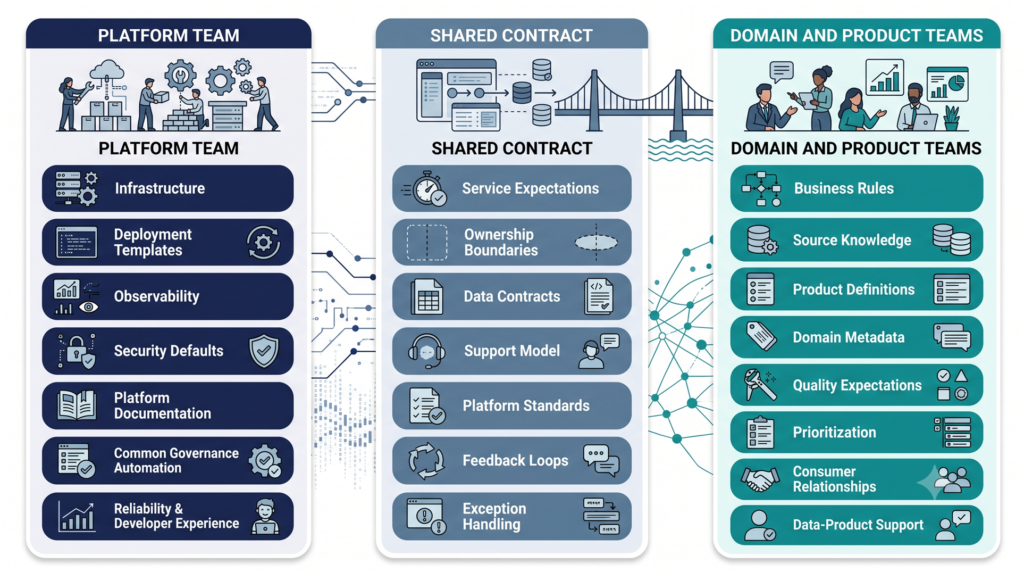
The boundary will vary by organization, but it must be explicit.
Without a clear boundary, platform teams become delivery bottlenecks and domain teams remain dependent.
The goal is not to decentralize everything.
The goal is to centralize reusable complexity while keeping business accountability close to the domain.
Run the platform like a product
A platform roadmap should not be a list of technical installations.
It should be a prioritized set of problems to solve for users.
This requires a platform product owner, regular user research, and evidence-based prioritization.
The platform team should speak with delivery teams frequently, not only when something has failed.
Useful questions include:
- What took longer than expected?
- Where did you need manual support?
- Which documentation was unclear?
- Which controls caused rework?
- What did you build that other teams may also need?
- Which platform feature exists but is difficult to use?
- Where did you choose a workaround instead of the standard path?
This feedback should influence the roadmap.
A platform capability that looks elegant in an architecture diagram may have little practical value if teams do not adopt it.
Similarly, a small improvement to access, templates, or documentation may save hundreds of hours across the organization.
Product thinking changes how platform work is prioritized.
Instead of asking, “What should we implement next?” ask:
“Which repeated source of friction should we remove next?”
Measure adoption, not installation
Platform programs often report metrics that are easy to collect but difficult to act on.
Examples include:
- number of tools deployed;
- number of environments created;
- infrastructure availability;
- storage capacity;
- number of platform services;
- number of catalog entries.
These metrics may be useful operationally, but they do not show whether the platform is improving delivery.
A stronger platform scorecard should include the following:
Time to first delivery
How long does it take a new team to deploy something useful?
Time to production
How long does a typical data change take from development to production?
Adoption of standard paths
What percentage of workloads use approved templates, deployment processes, and observability?
Reuse
How often do teams use shared components rather than creating their own?
Reliability
How frequently do platform-related failures occur, and how quickly are they resolved?
Support demand
What issues generate the most tickets, messages, and manual intervention?
User satisfaction
Do engineers, analysts, and product owners find the platform usable?
Data-product outcomes
Are products easier to discover, more reliable, and more widely used?
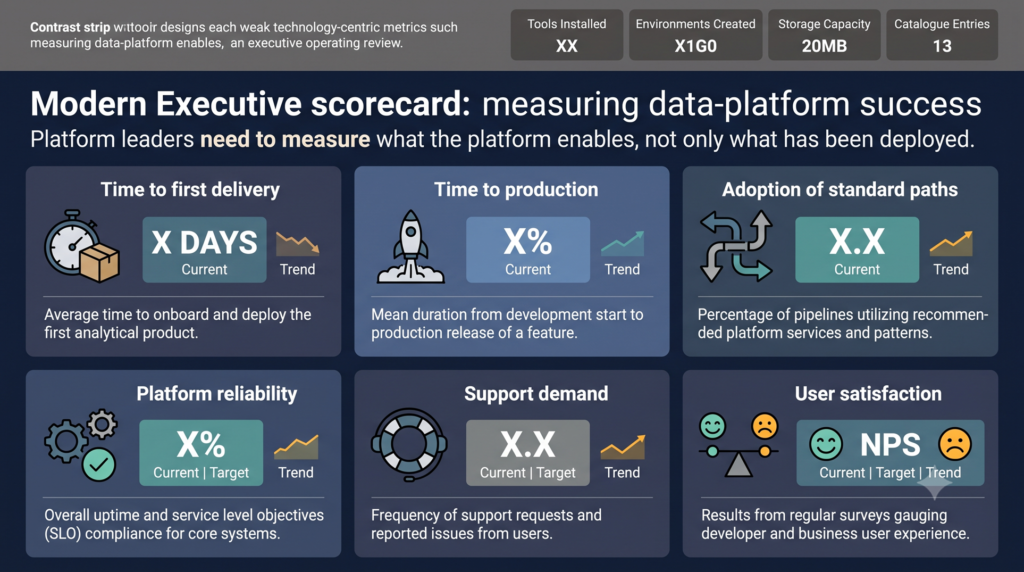
These measures create a more honest view of platform maturity.
A platform with high availability but low adoption is not successful.
A platform with many users but constant manual support is not scalable.
A platform with strong controls but slow delivery is not balanced.
Use support data to improve the platform
Every support request is evidence about the platform experience.
If teams repeatedly ask how to deploy, the deployment path is not clear enough.
If they frequently request manual access changes, the access model may not support common scenarios.
If production failures are caused by the same configuration issue, the platform should prevent that configuration.
If users cannot find trusted data, the problem may be metadata quality rather than catalog availability.
Platform teams should classify support requests by root cause.
For example:
- missing documentation;
- unclear process;
- insufficient automation;
- platform defect;
- access delay;
- missing capability;
- governance ambiguity;
- user training.
Review the largest categories each month.
The goal should not be to handle support tickets faster forever.
The goal should be to design recurring support needs out of the platform.
Avoid building a platform nobody asked for
There is a common pattern in large platform programs.
A central team spends months building a comprehensive solution based on architectural principles. By the time the platform is released, delivery teams have already developed alternatives because they could not wait.
The organization then faces an adoption problem.
The platform team believes users are resisting standards. Users believe the platform does not support real work.
Both may be partly right.
To avoid this, platform development should happen alongside real delivery use cases.
Choose one or two product teams as early adopters.
Build the platform path with them, not for them.
Observe where they struggle. Improve the templates, controls, and documentation. Then onboard the next group.
This approach may appear slower at the beginning, but it reduces the risk of building capabilities based on assumptions.
A platform should earn adoption through usefulness.
Mandates may increase usage numbers, but they do not create a good platform.
A practical 90-day plan for data leaders
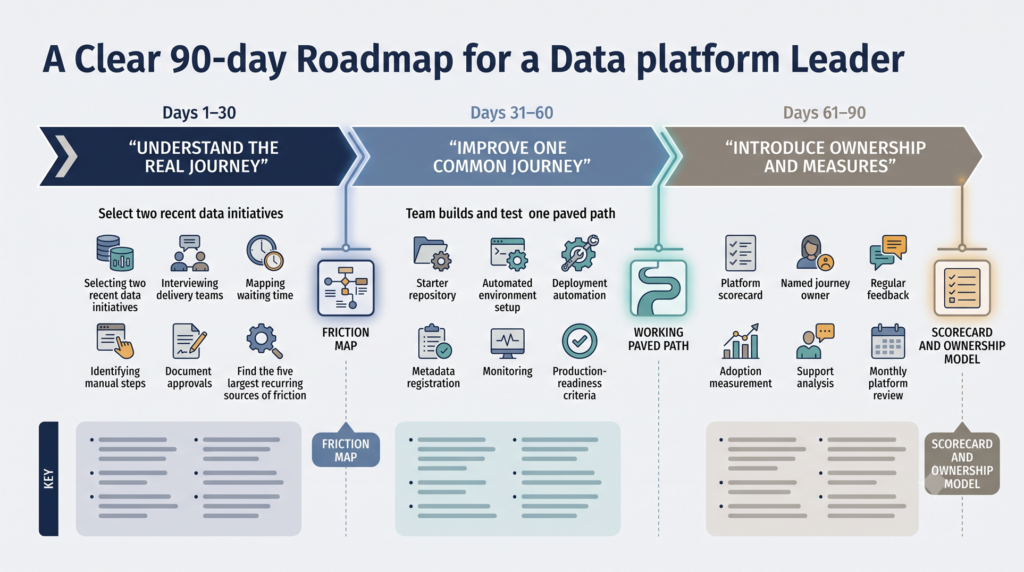
A data leader does not need to redesign the entire platform organization at once.
The first 90 days should focus on visibility, friction, and ownership.
First 30 days: understand how work actually happens
Select two recent data initiatives and reconstruct their delivery journey.
Document:
- how the teams were onboarded;
- which approvals were needed;
- where they waited;
- which platform services they used;
- where they created custom solutions;
- which controls caused rework;
- what support they required;
- how long production deployment took.
Speak directly with the people who performed the work.
Do not rely only on leadership reporting. The most important friction often exists between formal process steps.
At the end of 30 days, identify the top five repeated sources of delay.
Days 31 to 60: improve one high-volume journey
Choose one common journey, such as publishing a new curated dataset.
Create a simple standard path that includes:
- a starter repository;
- environment configuration;
- automated deployment;
- testing requirements;
- quality checks;
- ownership metadata;
- monitoring;
- production-readiness criteria.
Test the path with a real team.
Measure the number of manual steps before and after the change.
Do not wait for the solution to cover every edge case. Make the common case work well.
Days 61 to 90: introduce platform measures and ownership
Assign clear ownership for the selected user journey.
Create a small platform scorecard with five or six outcome measures.
Start with:
- onboarding time;
- time to first production deployment;
- adoption of the standard path;
- support volume;
- platform-related failure rate;
- user satisfaction.
Review these measures monthly with both platform and delivery leaders.
The purpose is not to create another reporting exercise.
The purpose is to identify where the platform is helping and where it is creating friction.
Questions every data leader should ask
A platform leadership review should go beyond architecture status.
Ask:
- Which teams are using the platform successfully?
- Which teams are avoiding it, and why?
- How long does onboarding take?
- What work still requires manual intervention?
- Which platform capability creates the most support demand?
- What do teams rebuild repeatedly?
- Which governance controls are automated?
- Which controls still depend on late review?
- How much of the platform roadmap comes from user feedback?
- What evidence shows that delivery is becoming faster or safer?
- Who owns the end-to-end user experience?
- Which platform metrics are tied to business delivery?
These questions will reveal more about platform maturity than a list of installed technologies.
Common mistakes to avoid
Starting with tool selection
Tool selection matters, but it should follow a clear understanding of user needs, operating constraints, and delivery patterns.
A new tool rarely fixes an unclear process.
Calling documentation self-service
Documentation is necessary, but self-service means users can complete a task independently.
A page that explains how to raise five separate tickets is not self-service.
Automating a poor process
Automation can make an inefficient process run faster without making it better.
Remove unnecessary steps before automating them.
Building for every possible use case
Trying to support every workload from the beginning creates complexity and delays value.
Start with common patterns and define a clear exception route.
Measuring only availability
Availability is important, but a highly available platform that is difficult to use will still be bypassed.
Treating governance as an external gate
Governance should shape templates, defaults, and delivery pipelines.
It should not appear only at the end.
Keeping the platform team too far from delivery
Platform teams need regular contact with real users and real workloads.
Otherwise, they optimize for technical completeness rather than practical usefulness.
The leadership shift
The move from a technology project to a platform capability requires a change in leadership behavior.
Data leaders must spend less time asking whether components have been implemented and more time asking whether teams can deliver effectively.
They must connect platform teams with users.
They must create clear ownership across technical boundaries.
They must fund documentation, onboarding, support, and user experience as core platform work.
They must insist that governance is built into delivery.
They must measure adoption, reuse, reliability, and speed.
Most importantly, they must accept that the platform is never finished.
Technology projects have implementation dates.
Platforms have users, roadmaps, service expectations, and continuous improvement.
Key takeaways
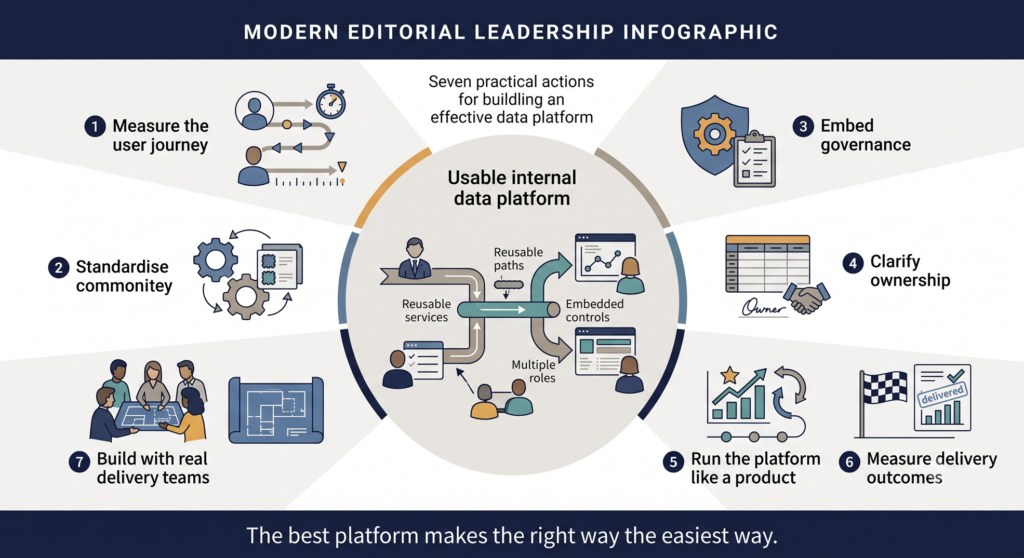
A modern data platform should reduce the effort required to deliver reliable data products. If it adds more handovers, approvals, and specialist dependencies, it is not yet functioning as a platform.
Data leaders should focus on a few practical actions:
- Measure the user journey.
Track how long it takes a team to onboard, build, deploy, and operate a data product. - Standardize common delivery patterns.
Provide paved paths for work teams to perform repeatedly. - Embed governance into the platform.
Turn policies into templates, defaults, and automated checks. - Clarify ownership.
Separate shared platform responsibilities from domain and product responsibilities. - Run the platform like a product.
Use feedback, adoption, and user outcomes to shape the roadmap. - Measure what the platform enables.
Focus on delivery speed, reuse, reliability, adoption, and support demand. - Start with real delivery teams.
Build platform capabilities alongside active use cases rather than in isolation.
The strongest data platforms are not necessarily the ones with the most advanced architecture.
They are the ones that make it easier for teams to do the right thing.
That is the real responsibility of the data platform leader.