
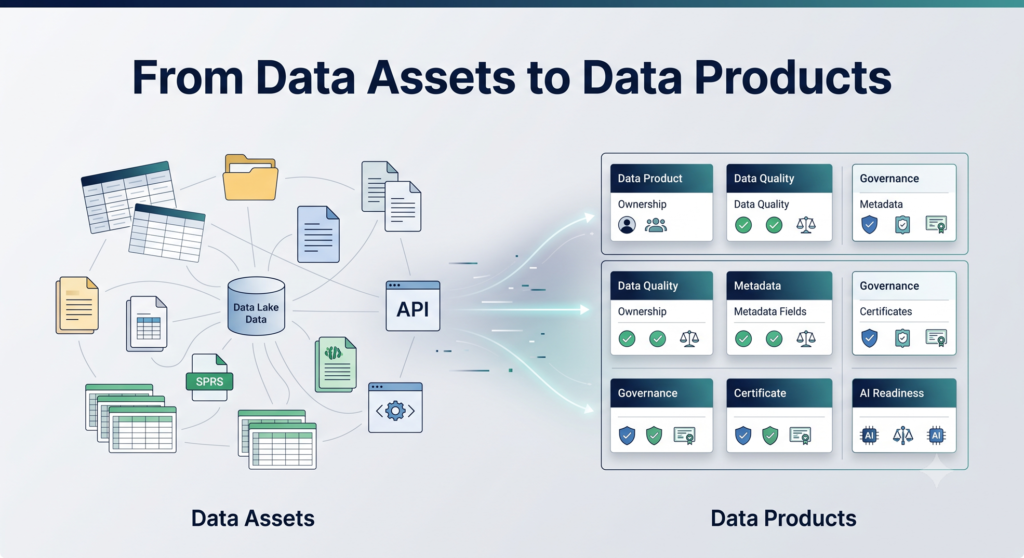
Most organizations already have plenty of data.
They have data lakes, warehouses, lakehouses, dashboards, reports, pipelines, catalogs, marts, extracts, APIs, spreadsheets, and hundreds of tables that people depend on every day.
Yet when a business team asks a simple question like, “Can we use this data for AI?” the answer is often not simple.
Someone has to check where the data came from. Someone has to confirm whether the definitions are correct. Someone has to ask who owns it. Someone has to validate quality. Someone has to understand whether sensitive fields are included. Someone has to find out whether the data is refreshed daily, weekly, monthly, or only when a pipeline does not fail.
That is the real issue.
The problem is not always the absence of data. The problem is that most enterprise data is still managed as an asset sitting somewhere, not as a product that people can confidently use.
This difference matters even more now because AI does not just consume data. AI amplifies the quality, context, gaps, and risks of that data.
If the data is unclear, AI will be unclear.
If the definitions are inconsistent, AI will repeat those inconsistencies.
If ownership is missing, no one will know who should fix the issue.
If the data is not governed, AI can create business, compliance, and trust problems very quickly.
That is why organizations need to move from managing data assets to building data products.
A Data Asset Is Not Automatically a Data Product
A data asset is any useful piece of data available inside the organization. It could be a table, file, report, dataset, API, dashboard, or data feed.
A data product is different.
A data product is a trusted, reusable, governed, and clearly owned data capability designed for consumption.
The difference is not only technical. It is operational.
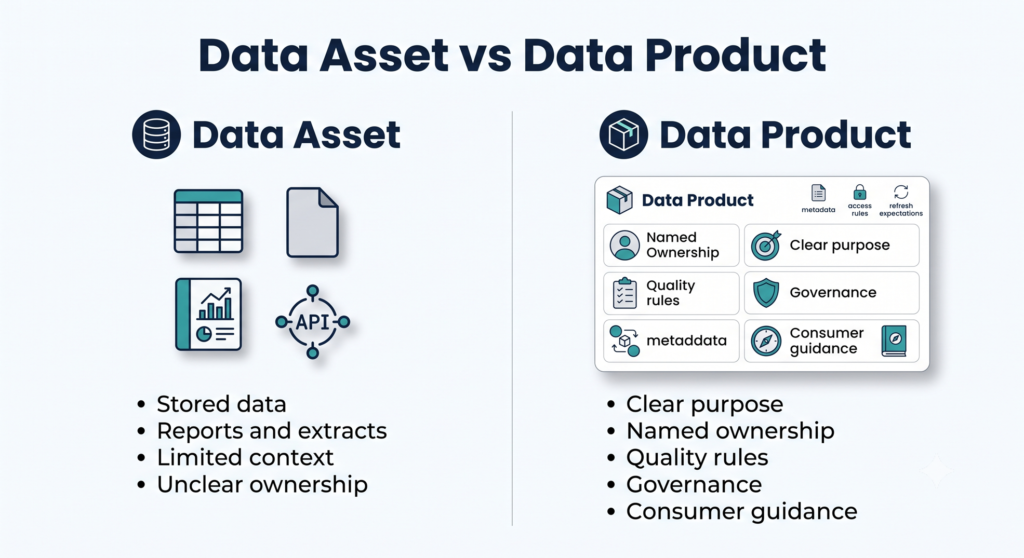
For example, a customer table in a warehouse is a data asset.
A customer data product would include:
- A clear business purpose
- Agreed customer definitions
- Named ownership
- Quality rules
- Refresh expectations
- Access controls
- Metadata
- Lineage
- Known limitations
- Consumer guidance
- A process for issue resolution
That is what makes it usable beyond one team, one report, or one project.
A table says, “Here is the data.”
A data product says, “Here is trusted data you can use, with context, rules, ownership, and support.”
That shift is important for analytics. It is critical for AI.
Why This Matters for AI Readiness
In traditional reporting, people often compensate for weak data foundations manually.
A business analyst knows which field to ignore.
A data engineer knows which pipeline has issues.
A finance user knows which report is “official.”
A domain expert knows that a particular column name is misleading.
This informal knowledge keeps many data ecosystems running.
AI does not have that informal knowledge unless we provide it.
AI systems need context. They need trusted definitions. They need reliable metadata. They need clear boundaries. They need good-quality data inputs. They need to know what data should be used, what should not be used, and where the risk areas are.
This is where data products become valuable.
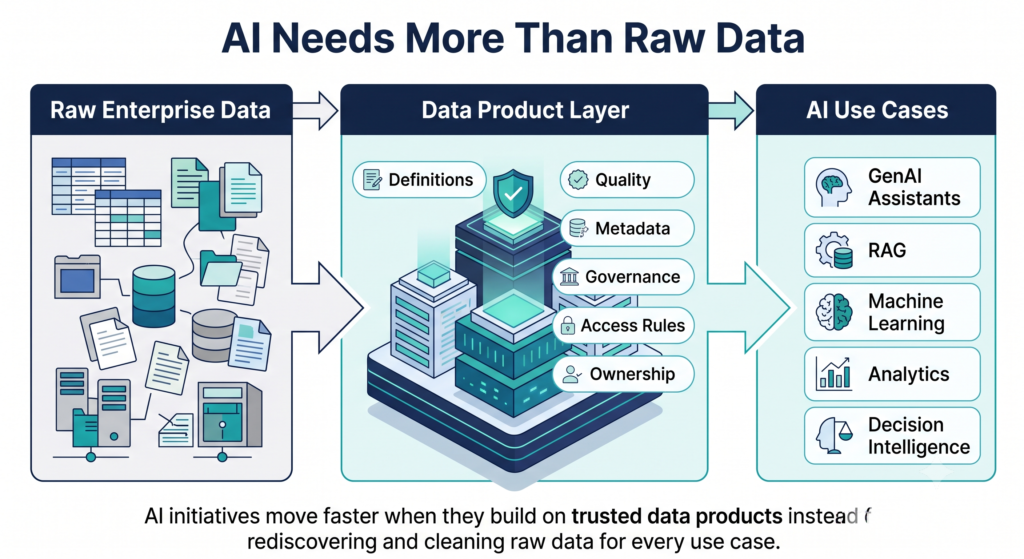
A well-designed data product gives AI systems a better starting point. It reduces ambiguity. It gives teams reusable, governed data building blocks instead of forcing every AI initiative to rediscover, clean, interpret, and validate data from scratch.
Without data products, every AI project becomes a custom data investigation.
With data products, AI teams can build on trusted foundations.
The Practical Shift: Stop Asking “Where Is the Data?”
Many organizations start with this question:
“Where is the data?”
That is a useful question, but it is not enough.
For AI readiness, leaders need to ask better questions:
- Who owns this data?
- What business process does it represent?
- What does each key field mean?
- How fresh does it need to be?
- What quality level is acceptable?
- Who is allowed to use it?
- What decisions or use cases can it support?
- What are its known limitations?
- What happens when the data is wrong?
- How do consumers request changes?
These questions turn data from a passive asset into an actively managed product.
The goal is not to make every dataset perfect. That is unrealistic.
The goal is to make high-value data reliable, understandable, reusable, and safe enough for the business and AI teams to use with confidence.
Start with High-Value Business Domains
A common mistake is trying to convert every table, report, and dataset into a data product.
That approach usually fails.
It creates too much documentation, too many ownership discussions, and too much process before the organization sees value.
A better approach is to start with a few high-value business domains.
For example:
- Customer
- Product
- Policy
- Claims
- Supplier
- Finance
- Risk
- Orders
- Inventory
- Employee
- Patient
- Contract
The right starting point depends on the organization. But the principle is simple: start where trusted data will unlock real business or AI value.
A bank may start with customer, transaction, risk, and product data.
An insurer may start with policy, claims, broker, carrier, and quote data.
A retailer may start with customer, product, inventory, order, and campaign data.
A healthcare organization may start with patient, provider, appointment, claims, and treatment data.
The first data products should not be chosen because they are technically easy. They should be chosen because they are valuable, reusable, and painful today.
A good starting question is:
“Which data do multiple teams keep asking for, cleaning, reconciling, or debating?”
That is often where a data product is needed.
What a Good Data Product Should Include
A data product does not need to be over-engineered. It does not need a fancy name, a new platform, or a large operating model on day one.
But it does need some basic elements.
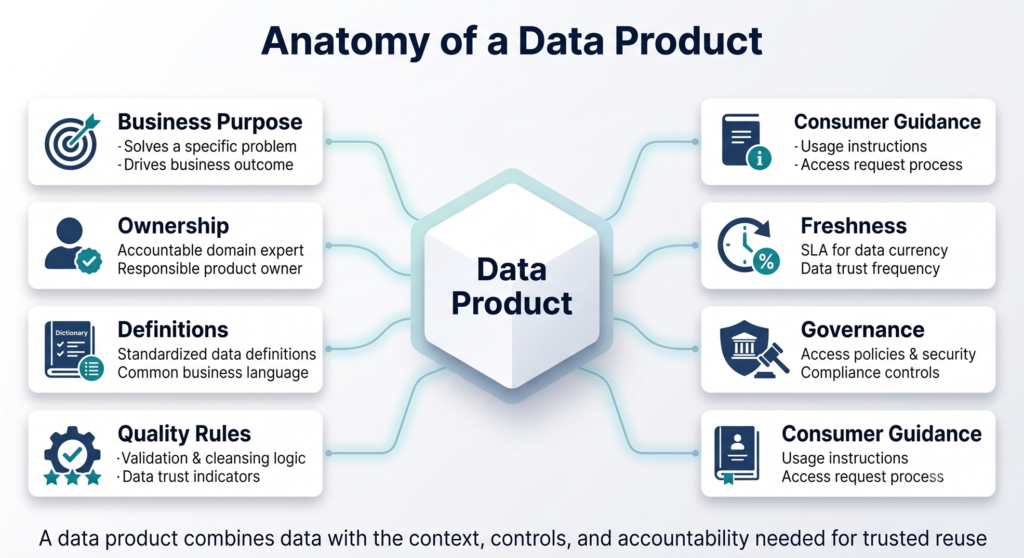
1. Business Purpose
Every data product should explain why it exists.
Not in technical language. In business language.
Weak description:
“This product contains customer data from source systems.”
Better description:
“This product provides a trusted view of active customers for analytics, segmentation, service reporting, and approved AI use cases.”
The business purpose should make it clear who the data is for and what decisions or processes it supports.
2. Ownership
A data product needs ownership from both sides: business and technology.
The business owner is accountable for meaning, usage, and priority.
The technical owner is accountable for pipelines, reliability, performance, and implementation.
Without ownership, a data product becomes another orphaned dataset.
When something breaks, no one knows who should respond. When a definition changes, no one knows who should approve it. When a new AI use case appears, no one knows whether the data is suitable.
Ownership is not a formality. It is how trust is maintained.
3. Clear Definitions
Definitions are often where data problems hide.
What is an active customer?
What is a closed claim?
What is net revenue?
What is a completed order?
What is a valid policy?
What is a high-risk supplier?
Different teams may answer these questions differently. That may be acceptable in some cases, but the difference must be visible.
A data product should document core business terms and key fields. It should also highlight where definitions vary by region, product line, function, or regulatory requirement.
This is especially important for AI because unclear definitions can lead to misleading outputs that sound confident.
4. Quality Expectations
A data product should define what “good enough” means.
Quality does not mean perfection. It means agreed expectations.
For example:
- Customer ID should not be null.
- The policy start date should be before the policy end date.
- Claim amount should not be negative unless there is a valid adjustment reason.
- Product code should match the approved reference list.
- Duplicate customer records should stay below an agreed threshold.
- Data should be refreshed by 8:00 AM every business day.
These rules should be visible and monitored.
The key is to move away from vague statements like “data quality is poor” and move toward measurable expectations.
5. Freshness and Reliability
AI and analytics use cases often fail because users do not know how current the data is.
A dashboard may look correct but use data from last week.
A model may use stale customer attributes.
A GenAI assistant may answer based on outdated policies.
A reporting team may build logic around a feed that fails silently.
A data product should clearly state:
- Refresh frequency
- Last successful update
- Expected availability time
- Known delays
- Pipeline reliability
- Issue escalation process
This helps consumers decide whether the data is suitable for their use case.
Not every product needs real-time data. But every product needs clarity.
6. Governance and Access Rules
A data product should make access rules explicit.
Who can use it?
What fields are restricted?
Does it contain personal, financial, health, or commercially sensitive data?
Can it be used for AI training?
Can it be used in a GenAI assistant?
Can it leave the organization?
Does usage require approval?
These questions cannot be handled casually.
For AI use cases, access and usage rules are just as important as data quality. A dataset may be technically accurate but still inappropriate for certain AI scenarios.
Good data products help teams move faster because the rules are already clear.
7. Metadata and Lineage
Consumers need to know where the data came from and how it was transformed.
This does not mean every technical detail must be exposed to every user. But the important context should be available.
At minimum, a data product should explain:
- Source systems
- Key transformations
- Important joins
- Business logic
- Downstream consumers
- Data refresh path
- Known dependencies
This helps with trust, troubleshooting, auditability, and impact analysis.
When a source field changes, teams should know which data products and AI use cases may be affected.
8. Consumer Guidance
A data product should help people use it correctly.
This is often missing.
Teams publish datasets but do not explain the right way to consume them. As a result, users guess. They join incorrectly. They filter incorrectly. They use the wrong date field. They apply logic that already exists somewhere else.
A practical data product should include simple guidance such as the following:
- Recommended use cases
- Not recommended use cases
- Common joins
- Key filters
- Sample queries
- Example metrics
- Known caveats
- Contact or support process
This guidance saves time and prevents misuse.
A Simple Data Product Template
Organizations do not need to wait for a perfect tool to start.
A simple data product template can create immediate discipline.
Here is a practical structure:
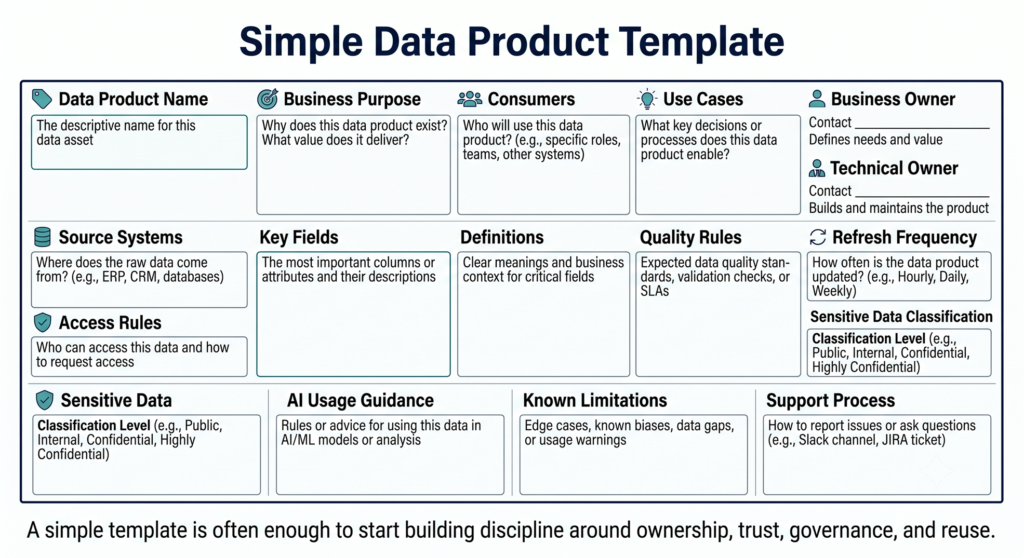
Data Product Name
Example: Customer 360, Claims Performance, Policy Portfolio, Supplier Risk
Business Purpose
What business need does this product serve?
Primary Consumers
Which teams or roles use it?
Supported Use Cases
Reporting, analytics, machine learning, GenAI, compliance, operational monitoring, etc.
Business Owner
Who owns the meaning and priority?
Technical Owner
Who owns delivery and reliability?
Source Systems
Where does the data come from?
Key Entities and Fields
What are the most important fields?
Business Definitions
What do key terms mean?
Quality Rules
What checks are applied?
Refresh Frequency
How often is it updated?
Service Expectations
When should it be available? What reliability is expected?
Access Rules
Who can access it and under what conditions?
Sensitive Data Classification
Does it include personal, confidential, regulated, or restricted data?
AI Usage Guidance
Can it be used for AI? Are there restrictions?
Known Limitations
What should consumers be careful about?
Support and Change Process
How do users raise issues or request changes?
This may look basic, but many organizations do not have this level of clarity for their most important datasets.
That is the point.
Data product thinking starts by making the important things explicit.
How to Build the First Data Product
The first data product should be small enough to deliver, but important enough to matter.
Do not start with a large enterprise-wide “customer everything” initiative that takes a year before anyone sees value.
Start with a clear, bounded use case.
For example:
- Active customers for segmentation and service analytics
- Open claims for operational reporting and AI-assisted triage
- Product catalog for search, recommendations, and analytics
- Approved suppliers for risk monitoring
- Policy portfolio for underwriting performance
- Contract metadata for a knowledge assistant
Once the scope is clear, follow a practical sequence.
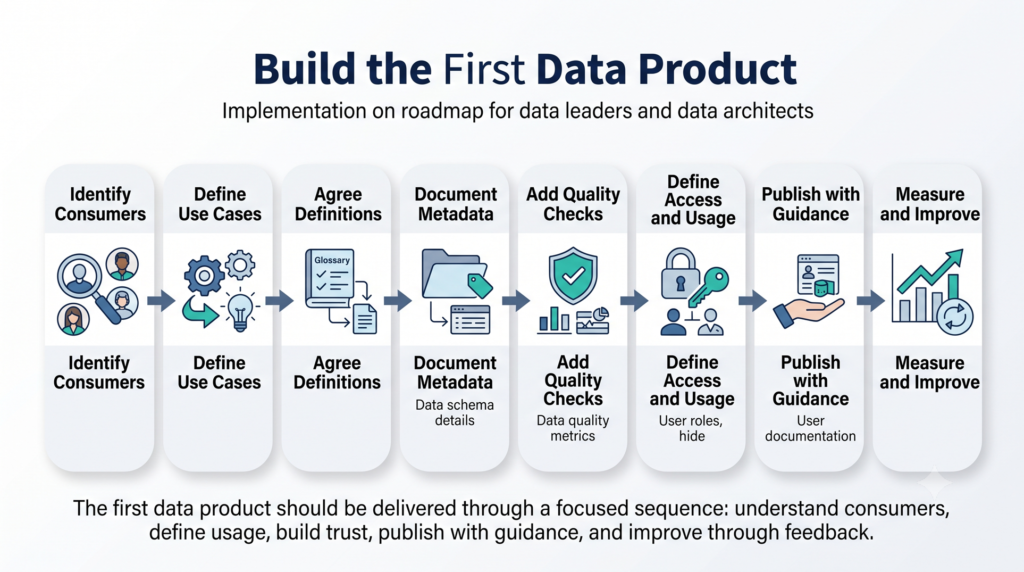
Step 1: Identify the Consumers
Start with the people who will use the data.
Ask them:
- What decisions do you need this data for?
- What do you currently struggle with?
- Which fields do you trust?
- Which fields do you avoid?
- Where do definitions differ?
- What manual work are you doing today?
- What would make this data easier to use?
This prevents the data product from becoming a technical publishing exercise.
A product exists because someone consumes it.
Step 2: Define the Use Cases
Do not define a data product only by its source system.
Define it by use cases.
For example, instead of saying,
“We are building a claims dataset.”
Say,
“We are building a claims performance data product to support operational reporting, claims leakage analysis, adjuster workload monitoring, and future AI-assisted claims summarization.”
That gives the product direction.
It also helps decide which fields, rules, and controls are needed.
Step 3: Agree the Core Definitions
Before building too much, align on the most important terms.
You do not need to solve every definition across the enterprise on day one. But for the product scope, the key definitions must be clear.
For example:
- What counts as an open claim?
- What counts as a reopened claim?
- What is the official claim closure date?
- How should reserves be represented?
- How should adjusted amounts be handled?
- Which claim types are excluded?
This discussion may feel slow, but it saves months of confusion later.
Step 4: Document the Minimum Metadata
Metadata should not be treated as a separate documentation project after delivery.
Capture it while building.
For each important field, document:
- Field name
- Business meaning
- Source
- Transformation rule
- Data type
- Allowed values where relevant
- Quality expectation
- Sensitivity classification
This gives consumers confidence and helps AI use cases understand context.
Step 5: Add Quality Checks
Start with a small number of meaningful quality rules.
Do not create fifty checks just because a tool allows it.
Choose rules that matter to business trust.
For example:
- Completeness of key identifiers
- Valid status values
- Duplicate detection
- Referential integrity
- Date logic
- Threshold checks
- Freshness checks
Make the results visible.
A data product should not only contain data. It should show whether the data is healthy.
Step 6: Define Access and Usage
Before publishing, clarify who can use the product and for what purpose.
This is especially important if the product may support AI use cases.
For example:
- Approved for internal analytics
- Approved for operational dashboards
- Approved for machine learning with controlled access
- Not approved for external sharing
- Not approved for GenAI usage without review
- Restricted fields masked for general consumers
These rules help teams move faster because they do not need to restart the governance conversation every time.
Step 7: Publish with Guidance
Publishing a data product should include more than making a table available.
Consumers should receive:
- Product description
- Owner details
- Data dictionary
- Quality status
- Refresh details
- Access process
- Sample queries
- Common use cases
- Known limitations
This is where the product mindset becomes visible.
The job is not finished when the pipeline runs. The job is finished when consumers can use the data correctly.
Step 8: Measure Usage and Improve
A data product should evolve.
Track basic signals:
- Who is using it?
- Which use cases depend on it?
- How often is it queried?
- Which fields are most used?
- What issues are reported?
- What quality rules fail most often?
- What new requirements are emerging?
This helps prioritize improvements.
Without usage feedback, data teams often improve what is technically interesting instead of what is valuable.
What Data Leaders Should Do Next
The shift to data products does not need to start with a large transformation program.
It can start with a focused 30-60-90-day plan.
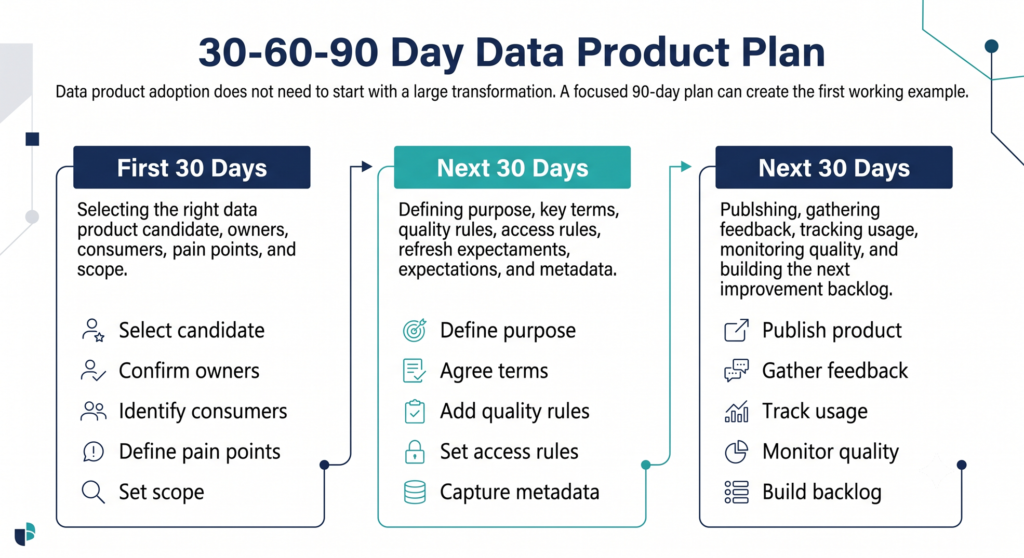
First 30 Days: Find the Right Starting Point
Identify three to five high-value data areas where teams already feel pain.
Look for data that is:
- Used by multiple teams
- Repeatedly reconciled
- Important for AI, analytics, or reporting
- Poorly documented
- Frequently debated
- High risk if misunderstood
Then select one candidate for the first data product.
Do not start with the biggest domain. Start with the clearest value.
By the end of 30 days, you should have:
- One selected data product candidate
- Defined business and technical owners
- Initial consumer group
- Draft use cases
- Known pain points
- Initial scope
Next 30 Days: Build the Product Foundation
Focus on the basics.
Define the business purpose, key consumers, main fields, ownership, quality rules, refresh expectations, and access requirements.
Build or refine the pipeline only after the product expectations are clear.
By the end of 60 days, you should have:
- Data product definition
- Key business terms
- Initial data dictionary
- Quality checks
- Access rules
- Refresh expectations
- Known limitations
- Sample consumption pattern
Next 30 Days: Publish, Measure, and Improve
Release the data product to a controlled group of consumers.
Do not wait until everything is perfect.
Let real users test whether the product is understandable, reliable, and useful.
By the end of 90 days, you should have:
- First published data product
- Consumer feedback
- Usage metrics
- Quality monitoring
- Issue resolution process
- Improvement backlog
- Reusable template for the next product
This creates momentum.
More importantly, it gives the organization a working example instead of another strategy document.
Common Mistakes to Avoid
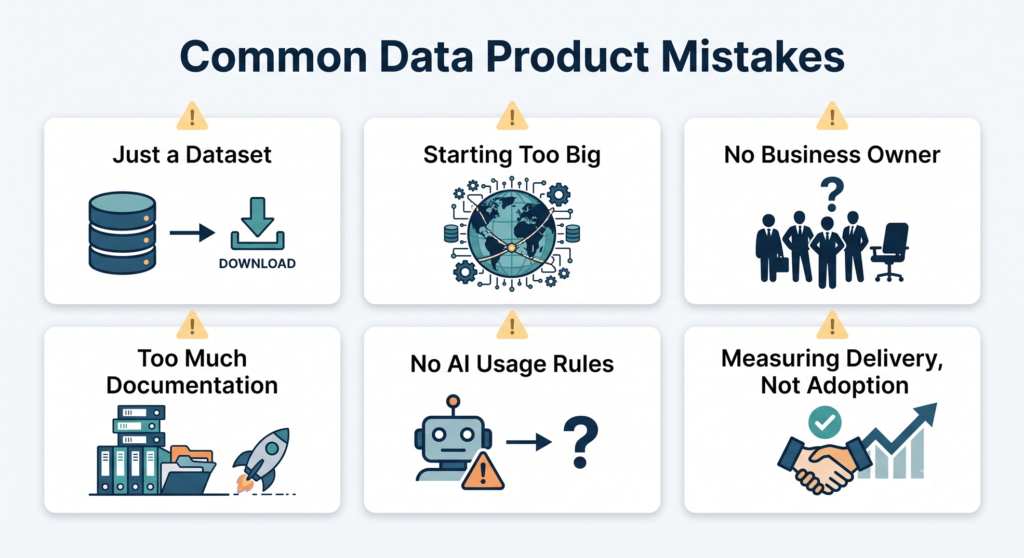
Mistake 1: Treating a Data Product as Just a Dataset
A dataset without ownership, quality rules, documentation, and usage guidance is not a product. It is still just a dataset.
Mistake 2: Starting Too Big
Trying to define enterprise-wide data products from day one can slow everything down. Start with one valuable product and build the operating model through delivery.
Mistake 3: Ignoring Business Ownership
Technology teams can build the pipeline, but they cannot own the business meaning alone. Without business ownership, trust will remain weak.
Mistake 4: Over-Documenting and Under-Delivering
Documentation matters, but it should support usage. A 40-page document that no one reads is not the goal. Clear definitions, practical examples, and visible quality signals are more useful.
Mistake 5: Forgetting AI Usage Rules
Not every data product should automatically be available for AI. Some data may be suitable for reporting but not for model training or GenAI applications. Usage boundaries must be explicit.
Mistake 6: Measuring Delivery Instead of Adoption
A data product is not successful because it was published. It is successful when people use it, trust it, and stop creating duplicate versions of the same data.
A Practical Example
Imagine an insurance organization wants to improve reporting and prepare for AI-assisted underwriting.
The data team decides to create a “Submission and Quote” data product.
Initially, the data exists in several systems. Brokers submit risks. Carriers respond with quotes. Documents are exchanged. Quote versions change over time. Different teams use different extracts to measure turnaround time, quote conversion, and carrier effectiveness.
The problem is not that data is unavailable. The problem is that teams do not have one trusted, reusable product for submission and quote analytics.
A practical data product would define:
- What counts as a submitted risk
- What counts as a quote response
- How quote versions are handled
- Which documents are linked to submission versus quotes
- How carrier response time is calculated
- How broker and carrier mappings are maintained
- Which statuses are included or excluded
- Which quality checks must pass
- Which fields are restricted
- Which AI use cases are allowed
Once this product exists, multiple teams can use it.
Analytics teams can build funnel and conversion dashboards.
Operations teams can monitor quote aging.
Leadership can review carrier responsiveness.
AI teams can explore summarization, search, and assistant use cases using governed data.
Governance teams can see ownership, lineage, and access rules.
That is the difference between a data asset and a data product.
The same raw data becomes more valuable because it is packaged with meaning, trust, and accountability.
The Real Leadership Shift
Data product thinking changes the role of data leadership.
The focus moves from platform delivery to value delivery.
A data leader should not only ask the following:
“Have we migrated the data?”
They should also ask:
“Is this data usable?”
“Is it trusted?”
“Is it owned?”
“Is it documented?”
“Is it monitored?”
“Is it governed?”
“Can AI teams safely use it?”
“Do consumers know how to apply it?”
“Are we reducing duplicate effort?”
“Are we improving business decisions?”
These are product questions, not just platform questions.
Modern data leadership requires both.
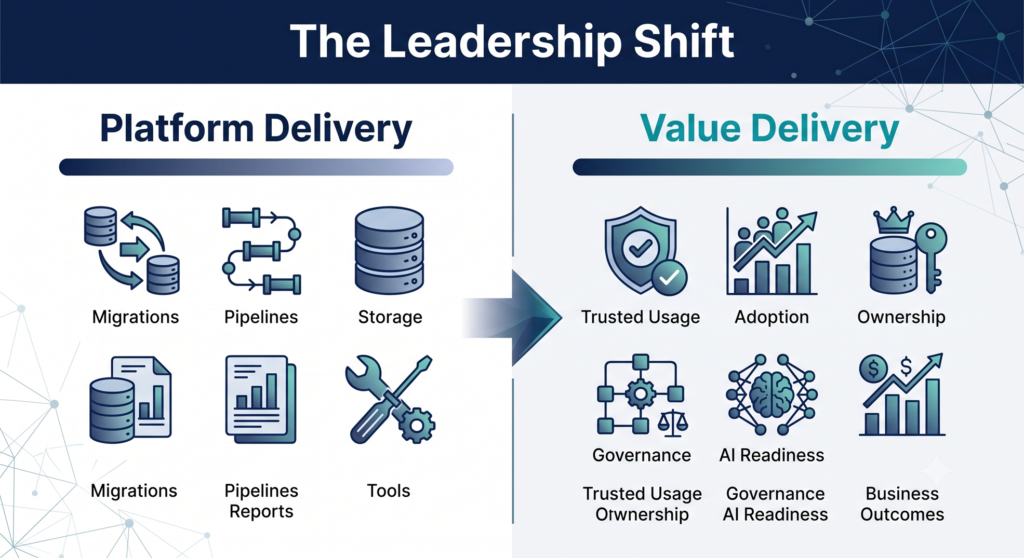
Platforms provide the foundation.
Data products create the usable business capability.
Key Takeaways
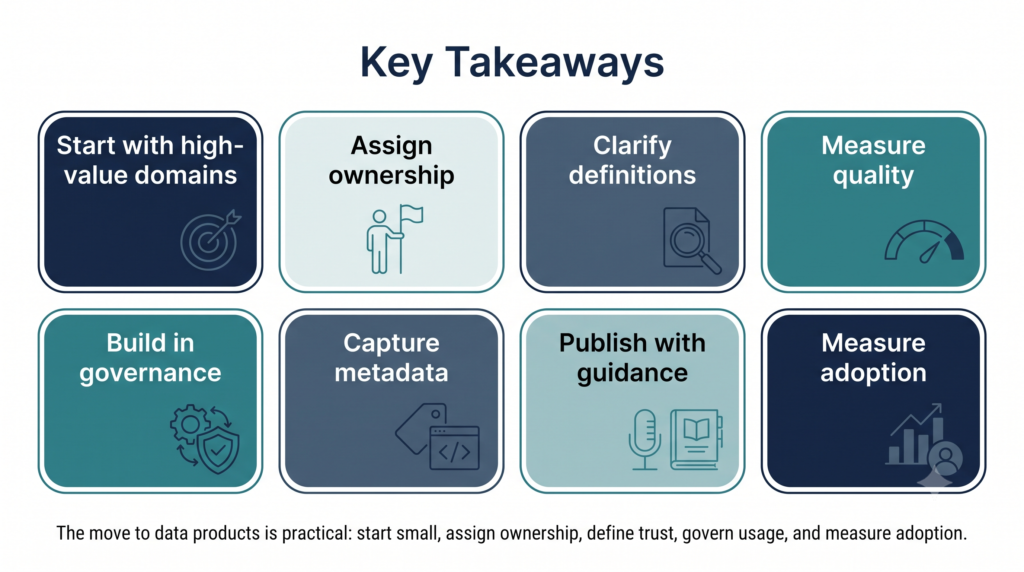
The move from data assets to data products is not a terminology change. It is a practical operating model shift.
Here are the most important takeaways:
- Do not try to productize everything. Start with high-value, high-reuse, high-pain data areas.
- A data product needs ownership. Without business and technical owners, trust will not scale.
- Definitions matter. AI and analytics both suffer when key business terms are unclear.
- Quality expectations must be measurable. “Good data” should mean specific rules, thresholds, and freshness expectations.
- Governance should be built in, not added later. Access rules, sensitivity classification, and AI usage guidance should be part of the product.
- Metadata is not optional. Consumers and AI systems both need context to use data correctly.
- Publishing is not enough. A product must include guidance, support, monitoring, and continuous improvement.
- Adoption is the real measure. A data product succeeds when teams use it, trust it, and stop rebuilding the same logic elsewhere.
Final Thought
AI-ready organizations are not built only by buying AI tools or modernizing data platforms.
They are built by making trusted data easier to find, understand, govern, and reuse.
That is the role of data products.
A data asset may sit inside a platform.
A data product serves a business purpose.
That difference is what turns data from something the organization stores into something the organization can confidently use.
And for AI, that confidence is not optional.