
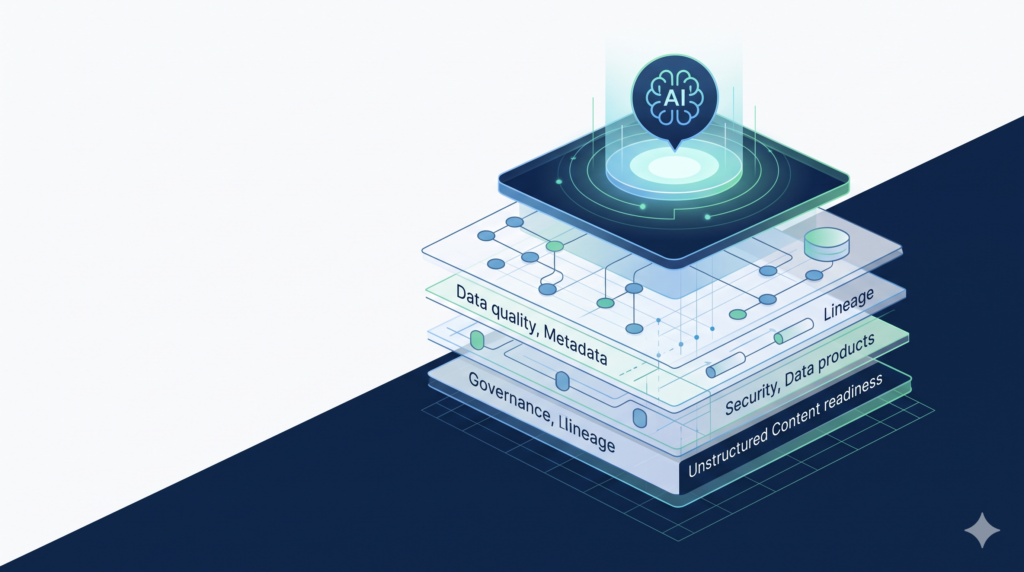
AI success does not begin with the model. It begins with the data.
Many organizations are moving quickly into AI, GenAI, copilots, chatbots, knowledge assistants, predictive models, and automation use cases. The excitement is understandable. The technology is powerful, accessible, and improving fast.
But there is a hard truth that every data leader, technology leader, and business leader must accept:
AI does not fix weak data foundations. It exposes them.
If your customer data is inconsistent, AI will generate inconsistent answers.
If your business definitions are unclear, AI will confidently explain the wrong metric.
If your documents are scattered, unclassified, and outdated, AI will retrieve the wrong context.
If your governance is weak, AI will create new risks faster than your teams can control them.
This is why AI readiness is not just a model problem. It is a data foundation problem.
The organizations that will get real value from AI are not simply the ones that buy the best tools. They are the ones that make their data trusted, discoverable, governed, reusable, and ready for both human and machine consumption.
The mistake many organizations make
A common AI journey looks like this:
The business wants a chatbot.
Technology selects a GenAI platform.
A team connects it to some documents or databases.
A demo works well enough.
Excitement builds.
Then reality appears.
The chatbot gives different answers for the same business question.
The source documents contain outdated policies.
The same customer has multiple records.
The KPI definition varies by region.
Access rules are unclear.
No one knows which data source is the official one.
The AI output cannot be trusted in production.
At that point, the conversation shifts from “Which model should we use?” to “Can we trust the data behind this?”
That question should have been asked at the start.
What “data foundations for AI” really means
Traditional data foundations were built mainly for reporting, dashboards, analytics, and regulatory needs. AI raises the bar.
For AI, data must be more than available. It must be understandable, contextual, governed, and usable at scale.
A strong data foundation for AI includes eight practical capabilities:
- Clear ownership of critical data
- Trusted and validated data sources
- Consistent business definitions
- Metadata, lineage, and cataloging
- Data quality monitoring
- Secure and governed access
- AI-ready unstructured content
- Reusable data products
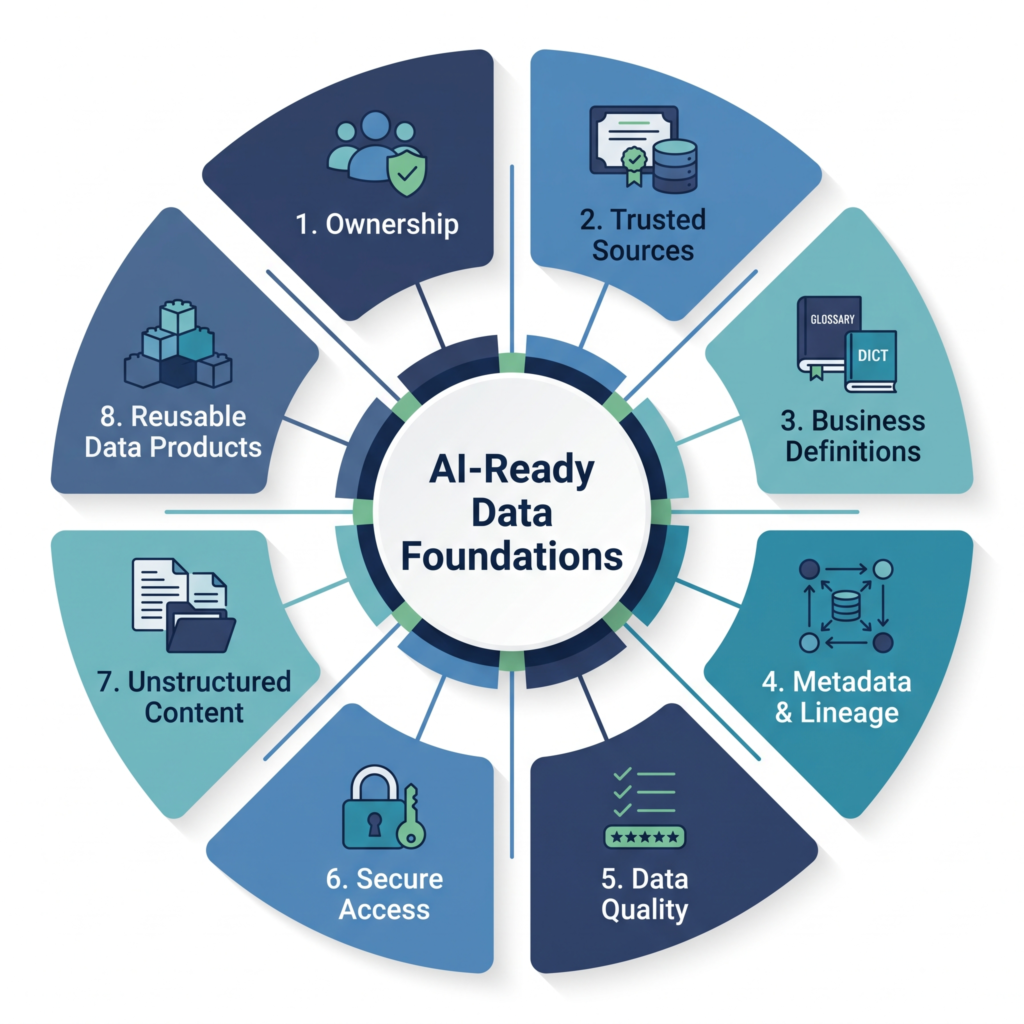
These are not abstract architecture concepts. They directly determine whether AI can deliver reliable business outcomes.
1. Identify the business use case before fixing the data
A common mistake is trying to “clean all data” before starting AI. That approach usually becomes too large, too slow, and too expensive.
A better approach is use-case-led data readiness.
Start with a specific AI use case. For example:
- A customer service assistant
- A claims document summarizer
- A sales intelligence assistant
- A policy comparison tool
- A financial risk monitoring agent
- An internal knowledge assistant
- A data quality anomaly detector
Then ask a simple question:
What data does this use case need to produce a trustworthy answer or action?
This immediately narrows the scope.
For a customer service assistant, you may need customer profile data, product data, support history, policy documents, and service rules.
For a claims assistant, you may need claim records, policy documents, correspondence, case notes, adjuster comments, and payment history.
For an executive AI dashboard, you may need trusted KPI definitions, metric lineage, finance data, sales data, and operational data.
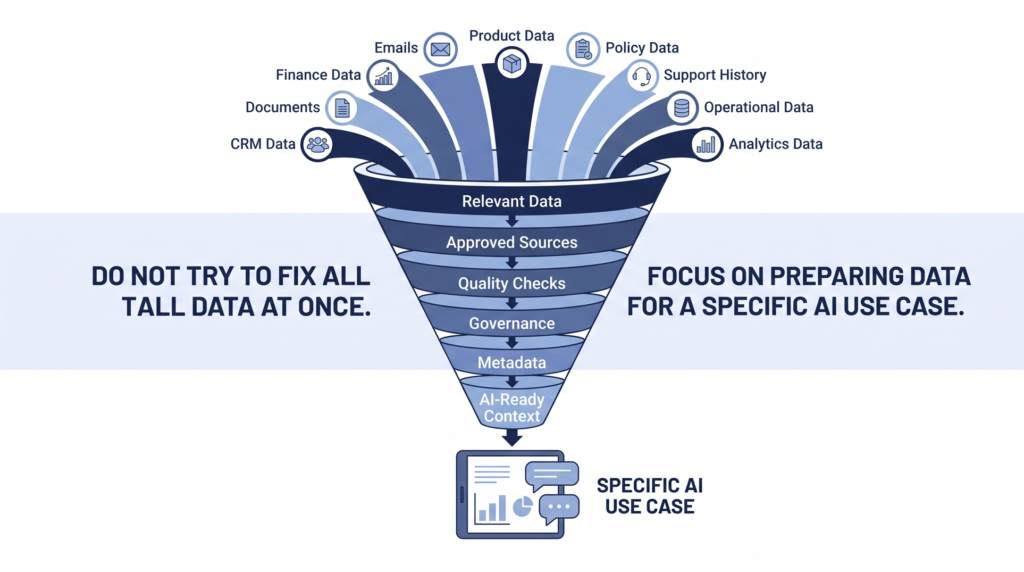
The action is not “fix enterprise data.”
The action is “make the data required for this AI use case trustworthy.”
2. Define what “trusted data” means
Everyone wants trusted data, but few organizations define it clearly.
For AI use cases, trusted data should meet five conditions:
It comes from an approved source.
The team knows which system, table, file, API, or document repository is authoritative.
It has a clear owner.
Someone is accountable for the meaning, quality, and lifecycle of the data.
It has a known freshness level.
The team knows whether the data is real-time, daily, weekly, monthly, or manually updated.
It has measurable quality rules.
Completeness, accuracy, duplication, validity, and consistency are monitored.
It has usage rules.
The team knows who can use it, for what purpose, and under what restrictions.
Without these five conditions, AI output will always carry hidden risk.
3. Build a data readiness checklist for every AI use case
Before connecting any AI system to enterprise data, run a simple readiness assessment.
Ask these questions:
Source readiness
- What are the source systems?
- Which source is the system of record?
- Are there duplicate sources for the same data?
- Is the data structured, semi-structured, or unstructured?
- How often is the data updated?
Quality readiness
- Are mandatory fields populated?
- Are business rules validated?
- Are duplicates identified?
- Are invalid values detected?
- Are historical changes tracked?
- Are quality issues visible to data owners?
Definition readiness
- Are key terms defined?
- Are KPIs standardized?
- Do different departments use the same definitions?
- Are calculation rules documented?
- Are exceptions clearly explained?
Governance readiness
- Who owns the data?
- Who can access it?
- Is sensitive data identified?
- Are retention rules defined?
- Are audit requirements understood?
- Is usage compliant with policy and regulation?
AI readiness
- Can the AI system retrieve the right data?
- Is the context complete enough?
- Is outdated content excluded?
- Are documents chunked and tagged properly?
- Can AI responses be traced back to source data?
- Can users see where the answer came from?
This checklist turns AI readiness from a vague ambition into an operational discipline.
4. Fix business definitions before scaling AI
One of the biggest risks in enterprise AI is inconsistent meaning.
A simple term like “customer” can mean different things across teams.
For sales, a customer may be an account with an active opportunity.
For finance, a customer may be a billing entity.
For operations, a customer may be a service recipient.
For compliance, a customer may be a legal party.
For marketing, a customer may include prospects and leads.
If an AI assistant is asked, “How many customers do we have?” which definition should it use?
Without a semantic foundation, AI will either guess or produce answers that look correct but are contextually wrong.
This is why organizations need a business glossary, metric definitions, and semantic consistency before scaling AI.
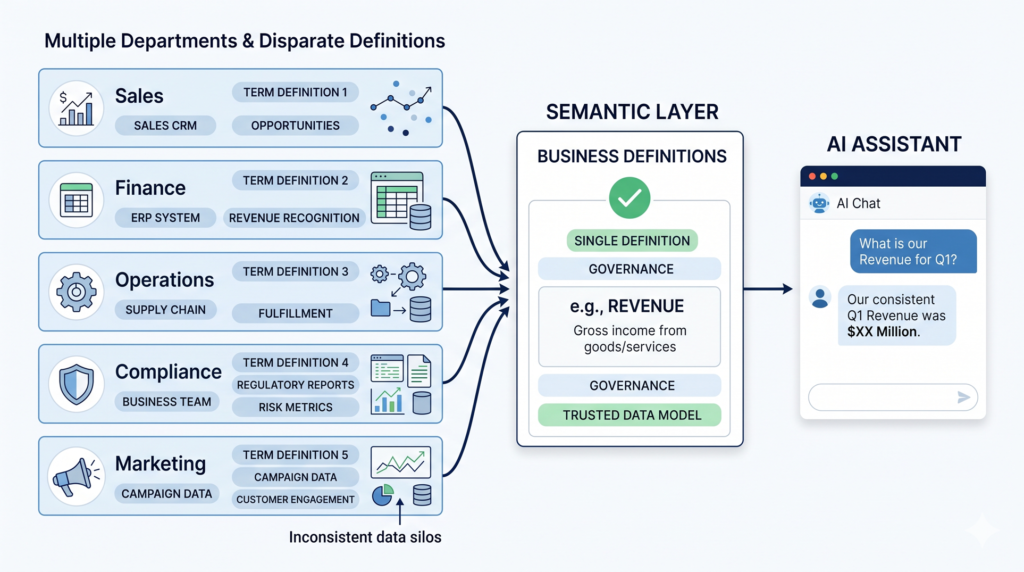
Start with the most important terms and metrics for the use case.
For example:
- Customer
- Policy
- Claim
- Product
- Revenue
- Renewal
- Active user
- Churn
- Margin
- Risk exposure
- Case resolution time
For each term, define:
- Business meaning
- Calculation logic, where applicable
- Authoritative source
- Data owner
- Known exceptions
- Approved usage
- Related terms
This does not need to start as a large enterprise glossary. It can begin as a focused glossary for one AI use case and expand over time.
5. Treat unstructured data as a first-class data asset
Many GenAI use cases depend heavily on unstructured data: PDFs, emails, contracts, policies, manuals, reports, notes, presentations, transcripts, and knowledge articles.
Most organizations have years of unstructured content, but very little structure around it.
That creates major AI problems.
Documents may be outdated.
The same policy may exist in multiple versions.
File names may be unclear.
Ownership may be missing.
Sensitive information may be embedded inside documents.
Important context may be buried in attachments.
AI retrieval may pull the wrong chunk from the wrong document.
For AI, unstructured data needs preparation.
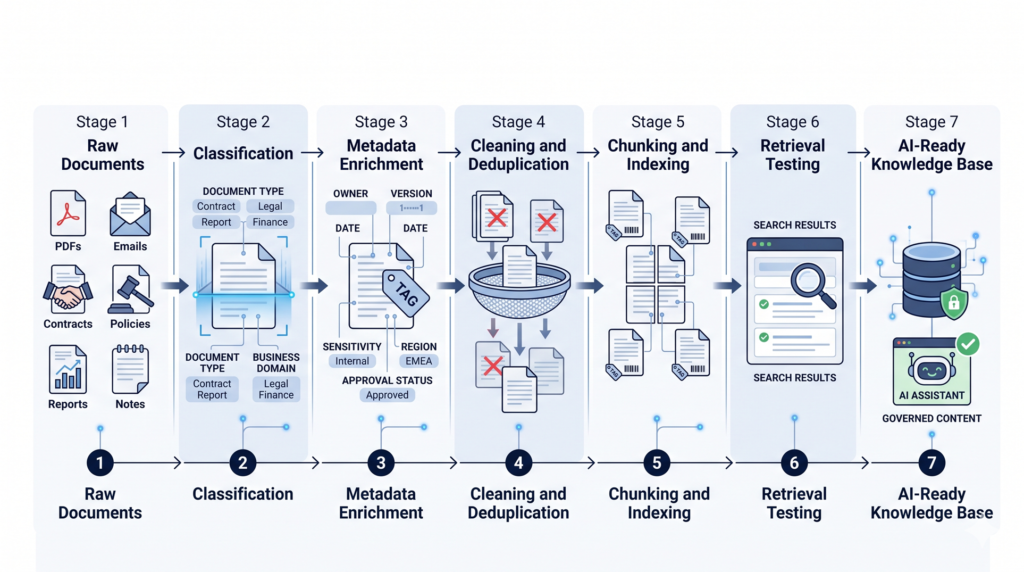
At minimum, organizations should classify and enrich documents with metadata such as the following:
- Document type
- Business domain
- Owner
- Creation date
- Last updated date
- Effective date
- Expiry date
- Version
- Region
- Product
- Customer segment
- Sensitivity level
- Source system
- Approval status
Then the content should be prepared for retrieval.
That means:
- Removing duplicate documents
- Separating current and outdated versions
- Extracting clean text from files
- Splitting content into meaningful chunks
- Attaching metadata to each chunk
- Preserving source references
- Testing whether retrieval returns the right context
This is where many GenAI pilots fail. They connect AI to documents before preparing the documents for AI.
A better rule is
Do not connect AI to a document repository until the content has ownership, metadata, version control, and retrieval testing.
6. Build data products, not one-off data extracts
AI initiatives often begin with quick extracts.
A team pulls data from a few systems, creates a temporary dataset, builds a demo, and proves the concept.
That may be fine for experimentation. But it does not scale.
Production AI needs reusable, governed, reliable data assets. This is where data products become important.
A data product is a curated data asset designed for reuse. It has a clear owner, defined consumers, documented meaning, quality expectations, access controls, and lifecycle management.
For AI, a data product may include:
- Clean structured datasets
- Curated document collections
- Standard KPI definitions
- Feature datasets for models
- Metadata-enriched knowledge bases
- Golden customer or product records
- Event streams
- Vector-ready content collections
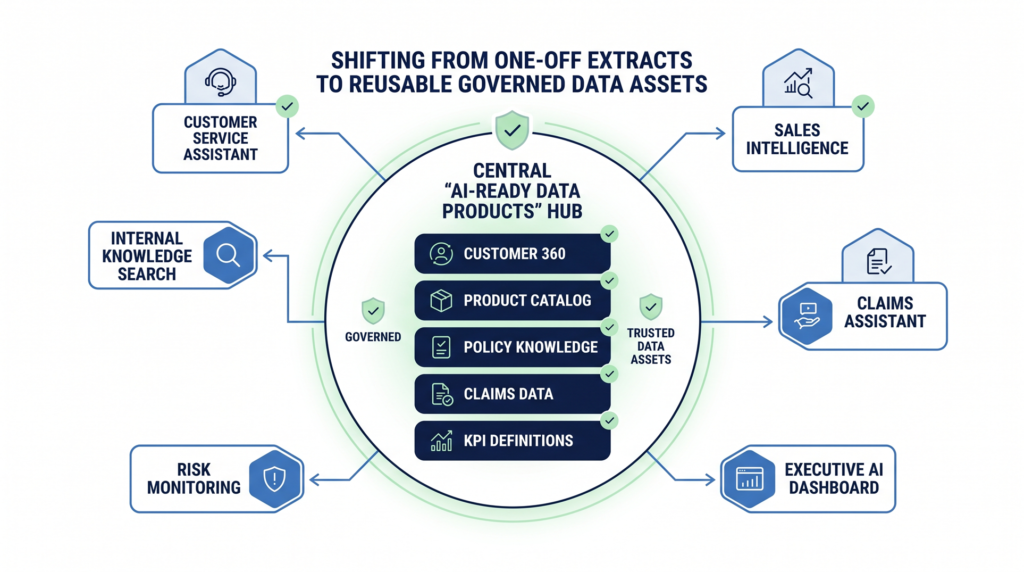
Instead of every AI team creating its own extract, the organization should create reusable data products that multiple AI use cases can consume.
For example:
A “Customer 360 Data Product” can support customer service AI, sales AI, churn prediction, personalization, and executive reporting.
A “Policy Knowledge Data Product” can support underwriting assistants, claims assistants, compliance review, and internal search.
A “Product Catalog Data Product” can support recommendation engines, customer support, pricing analysis, and sales enablement.
The shift is simple but powerful:
Move from project-specific data pipelines to reusable AI-ready data products.
7. Make data quality measurable
For AI, data quality cannot remain subjective.
It is not enough to say, “This data is good enough.” Teams need measurable quality rules.
Common data quality dimensions include:
- Completeness
- Accuracy
- Validity
- Consistency
- Timeliness
- Uniqueness
- Integrity
- Conformity
For each critical data element, define quality rules.
For example:
Customer email must follow a valid format.
Policy start date cannot be after policy end date.
The claim amount cannot be negative.
Product code must exist in the product master.
Customer ID must not be null.
Country code must follow a standard list.
A document marked “approved” must have an approval date.
A policy document must have an effective date.
Then define thresholds.
For example:
- Customer ID completeness must be 99.5% or higher.
- Duplicate customer records must be below 1%.
- Product code validity must be 100%.
- Critical policy documents must have owner metadata.
- Expired documents must not be used in AI retrieval.
This allows teams to decide whether a dataset is ready for AI consumption.
A useful operating principle is
No critical AI use case should go live without data quality rules, thresholds, and monitoring.
8. Add lineage and traceability
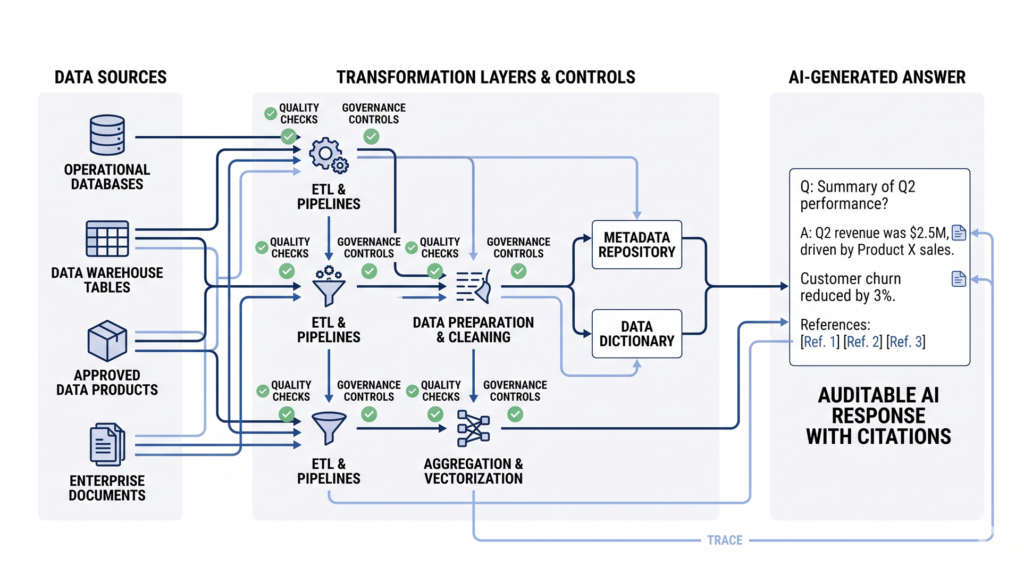
AI systems must be able to explain where their answers came from.
This is especially important in regulated industries; executive decision-making; finance; insurance; healthcare; legal; and compliance-heavy environments.
For structured data, teams need lineage from source to transformation to consumption.
For unstructured data, teams need traceability from AI answer to document, page, section, paragraph, or chunk.
This matters because users will ask the following:
Where did this answer come from?
Which source was used?
Was the source approved?
When was it last updated?
Was the data transformed?
Can I verify the answer?
Who owns the source?
Can this answer be audited?
Without lineage and traceability, AI becomes a black box. And black-box AI is difficult to trust in enterprise environments.
A practical requirement for AI systems should be
Every important AI-generated answer should provide source references or explain the data basis behind the response.
9. Strengthen access control before expanding AI access
AI can make data easier to access. That is both a benefit and a risk.
A user who could not previously find sensitive data might now ask a chatbot and receive it in seconds.
This is why access control must be designed before AI systems are widely deployed.
Organizations need to answer the following:
- What data can this AI use?
- Which users can access which data?
- Should access depend on role, region, department, or business purpose?
- How is sensitive data identified?
- Can the AI reveal personal, financial, confidential, or regulated information?
- Are prompts and responses logged?
- Are there controls to prevent unauthorized exposure?
- Are third-party AI tools allowed to process this data?
Access control for AI is not just about securing databases. It is about securing the full interaction pattern between users, data, models, prompts, responses, and logs.
A useful rule is:
AI should not give a user access to data they could not access through approved business systems.
10. Create an AI data-readiness score
To make progress visible, create a simple scoring model for AI data readiness.
For each AI use case, score the required data across key dimensions.
Example scoring areas:
| Area | Question | Score |
|---|---|---|
| Source clarity | Do we know the authoritative source? | 1–5 |
| Ownership | Is there a named business and technical owner? | 1–5 |
| Quality | Are quality rules defined and monitored? | 1–5 |
| Definitions | Are key terms and KPIs documented? | 1–5 |
| Metadata | Is the data cataloged and searchable? | 1–5 |
| Lineage | Can we trace data from source to consumption? | 1–5 |
| Governance | Are access and usage rules defined? | 1–5 |
| AI retrieval | Can AI retrieve the right context reliably? | 1–5 |
| Observability | Are data issues monitored after go-live? | 1–5 |
This creates a practical conversation with business stakeholders.
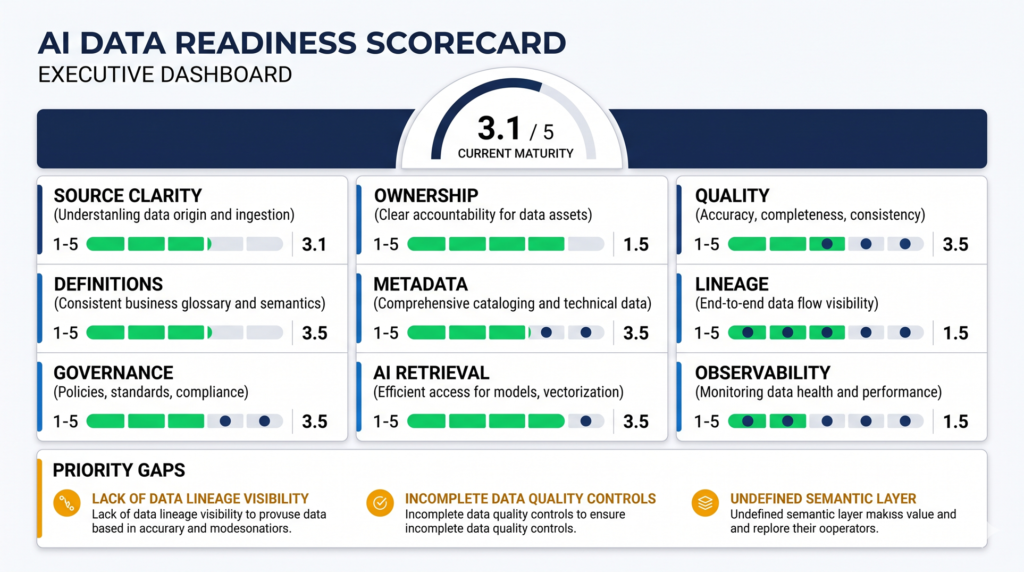
Instead of saying, “Our data is not ready,” you can say:
“The customer service assistant has a readiness score of 3.1 out of 5. The main gaps are document ownership, duplicate customer records, and missing product definitions. If we fix those three areas, we can move toward production with lower risk.”
That is a much better leadership conversation.
11. Define the minimum viable data foundation
Organizations do not need to solve everything before starting AI.
But they do need a minimum viable data foundation for each serious use case.
A minimum viable data foundation should include the following:
- Approved source systems
- Named data owners
- Documented business definitions
- Critical data quality rules
- Access controls
- Basic metadata
- Source traceability
- Data refresh expectations
- Issue management process
- Monitoring after go-live
This is enough to move from experimentation to controlled production.
The goal is not perfection. The goal is managed trust.
12. Move from AI pilots to AI operating model
Many AI pilots succeed technically but fail organizationally.
Why?
Because no one owns the data after the demo.
No one monitors quality.
No one updates the knowledge base.
No one retires outdated documents.
No one reviews access changes.
No one tracks whether AI answers remain accurate.
No one has funding for ongoing data maintenance.
AI needs an operating model, not just a project team.
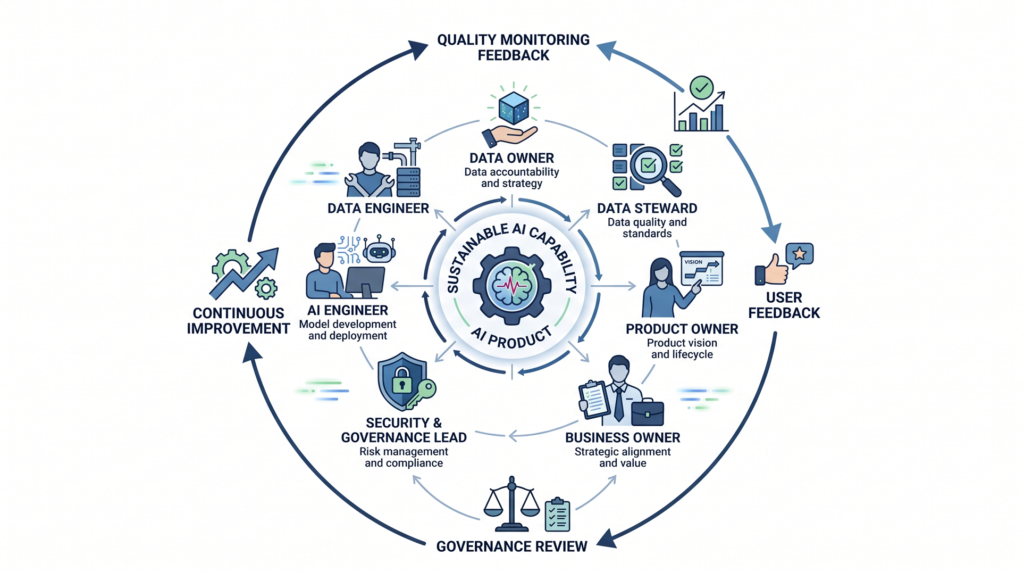
At minimum, define the following roles:
Business owner
Owns the use case, outcomes, and decision-making context.
Data owner
Owns the meaning, quality, and business rules of the data.
Data steward
Manages definitions, metadata, issue resolution, and quality follow-up.
Data engineer
Builds and maintains pipelines, transformations, and data products.
AI or ML engineer
Builds model integration, retrieval logic, evaluation, and application behavior.
Security and governance lead
Ensures access, compliance, privacy, and policy alignment.
Product owner
Manages backlog, adoption, feedback, and continuous improvement.
AI is not a one-time implementation. It is a living capability. The data foundation must be operated the same way.
A practical 30-60-90-day action plan
Data foundations for AI can feel overwhelming. The best way to start is with a focused plan.
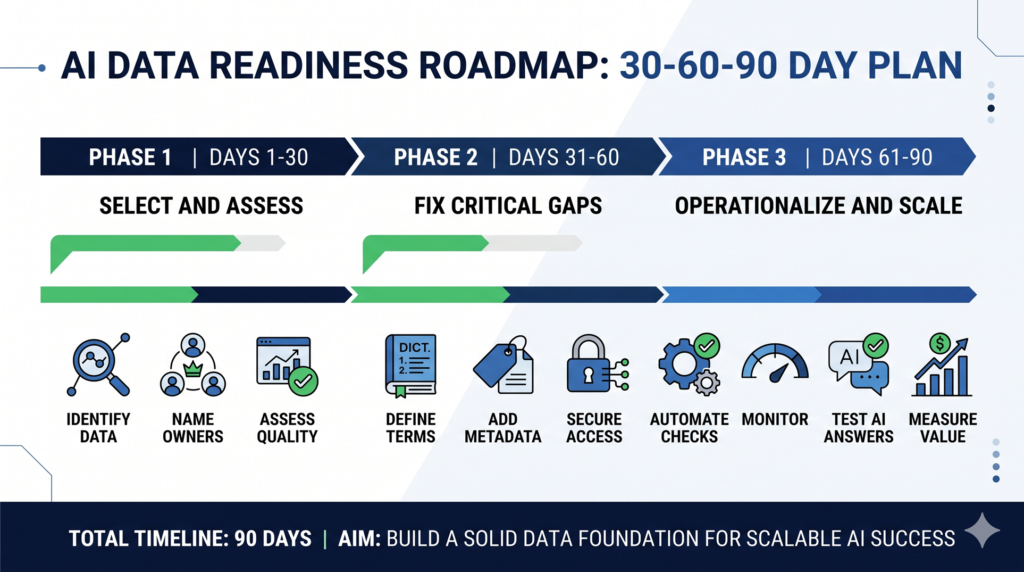
First 30 days: select and assess
Choose one high-value AI use case.
Then:
- Identify the data and documents required
- Confirm source systems
- Name business and technical owners
- Document key terms and KPIs
- Review known data quality issues
- Identify sensitive data
- Check access rules
- Assess document freshness and duplication
- Create an initial AI data readiness score
The goal of the first 30 days is not to fix everything. It is to understand the real readiness gap.
Days 31-60: fix the critical gaps
Focus on the issues that directly affect AI trust.
For example:
- Remove duplicate or outdated documents
- Define the top 10 business terms
- Create quality rules for critical fields
- Establish approved source datasets
- Add metadata to important documents
- Implement role-based access
- Create source references for AI outputs
- Build a curated data product for the use case
The goal of this phase is to move from raw data access to controlled, trusted data consumption.
Days 61-90: operationalize and scale
Prepare the use case for production and reuse.
Actions include:
- Automate quality checks
- Set up monitoring and alerts
- Define issue ownership and resolution process
- Test AI answers against known scenarios
- Review governance and security
- Train users on limitations and source references
- Measure adoption and business value
- Identify reusable data products for the next AI use case
The goal is to create a repeatable pattern for future AI initiatives.
What leaders should ask before approving an AI use case
Before approving a production AI use case, leaders should ask these questions:
- What data will the AI use?
- Who owns that data?
- Is the data trusted and validated?
- Are the business definitions clear?
- Is sensitive data protected?
- Can users verify the AI response?
- Are outdated sources excluded?
- Is quality monitored continuously?
- Who fixes data issues after go-live?
- Can this data foundation be reused for other use cases?
These questions shift the discussion from AI excitement to AI readiness.
The real value of strong data foundations
Strong data foundations do more than reduce AI risk. They increase AI speed.
When trusted data products exist, new AI use cases move faster.
When definitions are clear, teams spend less time debating numbers.
When metadata is available, data discovery improves.
When quality is monitored, teams catch problems early.
When governance is embedded, security reviews become smoother.
When lineage exists, trust increases.
When unstructured data is prepared, GenAI becomes more reliable.
The payoff is not just better AI. It is a better data organization.
Key takeaways
AI readiness starts with data readiness.
Do not begin by asking which model to use. Begin by asking which business problem you are solving and what data is required to solve it reliably.
Do not try to fix all enterprise data at once. Start with one use case and make its data trustworthy.
Do not treat unstructured content as an afterthought. Documents, policies, contracts, emails, and knowledge articles need ownership, metadata, version control, and retrieval testing.
Do not scale AI on unclear definitions. Standardize key business terms and KPIs before allowing AI to answer business-critical questions.
Do not move AI into production without quality rules, access controls, traceability, and monitoring.
Most importantly, do not think of data foundations as a slow governance exercise. Think of them as the accelerator for trusted AI.
The organizations that win with AI will not be the ones that experiment the most. They will be the ones that turn trusted data into reusable intelligence.
Before asking, “Which AI tool should we use?” leaders should ask a better question:
Is our data ready for AI to use it safely, accurately, and repeatedly?