
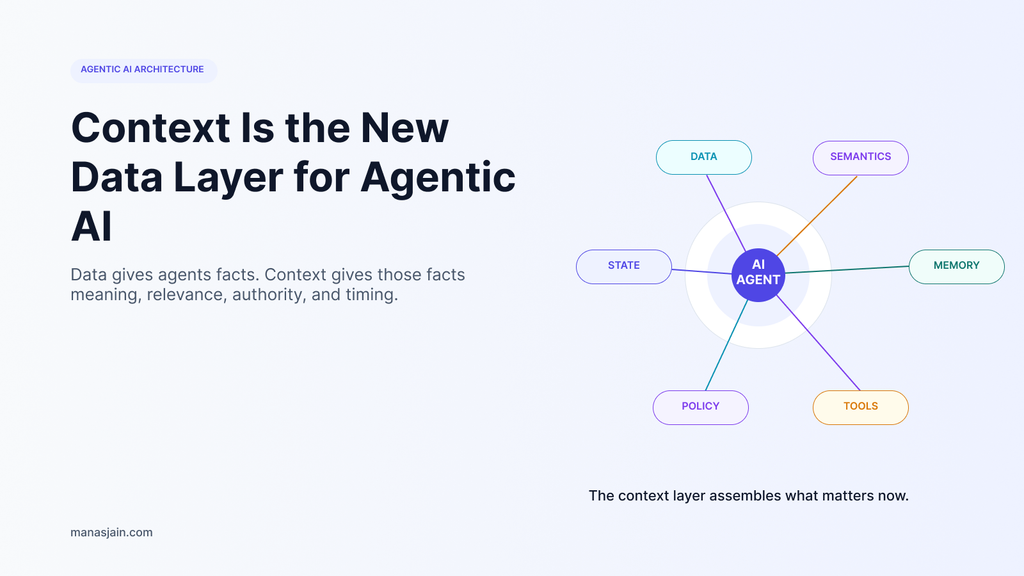
The Next AI Bottleneck Is Not the Model. It Is Context.
For the last several years, enterprises have focused on making data available to AI.
They built data lakes and lakehouses. They modernized pipelines. They created APIs, semantic models, catalogs, vector databases, knowledge graphs, and retrieval-augmented generation systems.
All of that still matters.
But agentic AI changes the architecture problem.
An AI agent does not simply need access to information. It must determine what information matters now, what it means, what it is allowed to use, what has already happened, what actions are available, and what should happen next.
That requires something more than a traditional data layer.
It requires a context layer.
The distinction is important:
Data tells an agent what exists. Context tells the agent what matters for the decision it is making right now.
Imagine an enterprise agent asked,
“Why did revenue decline last month, and what should we do about it?”
Giving the agent access to every revenue table is not enough.
It may also need to know:
- which revenue definition Finance considers authoritative;
- which business calendar defines “last month”;
- whether refunds are included;
- what product launches occurred;
- which regions experienced outages;
- whether pricing changed;
- what the user is authorized to see;
- which analysis has already been performed;
- which tools can query the relevant systems;
- which assumptions were rejected in previous interactions;
- and what level of confidence is required before recommending an action.
The raw data might already exist.
The missing ingredient is often context.
That is why context engineering is emerging as a natural evolution beyond prompt engineering. Anthropic, for example, describes context engineering as managing the complete information state available to an agent—including instructions, tools, external information, conversation history, and other runtime signals—rather than simply improving the wording of prompts. It also highlights an important constraint: more context is not automatically better. Large amounts of irrelevant information can reduce the model’s ability to focus on what actually matters.
For enterprise AI, this has a major architectural implication:
Context cannot remain an application-level afterthought. It needs to become a governed platform capability.
Why Context Is Becoming an Enterprise Architecture Problem
Traditional analytics systems operate primarily around relatively deterministic flows.
A pipeline reads data.
A transformation applies business logic.
A semantic model exposes metrics.
A dashboard presents the results.
Agentic systems behave differently.
An agent may:
- interpret a user’s intent;
- retrieve information from several sources;
- choose a tool;
- execute an action;
- inspect the result;
- revise its plan;
- ask another agent for help;
- remember something it learned
- wait for an external event;
- resume the workflow hours or days later.
The information required at step eight may be very different from the information required at step two.
This means the system continuously has to answer a new question:
What is the smallest, most relevant, trustworthy set of information this agent needs for its next decision?
That question sits at the intersection of data engineering, metadata, semantics, governance, retrieval, security, application state, and AI engineering.
And it becomes especially important as agentic workloads move from demonstrations into real enterprise workflows.
Google’s work on long-running agents, for example, explicitly addresses workflows that must pause and resume over days or weeks while retaining state rather than behaving like stateless chatbots.
OpenAI’s description of its internal data agent provides another useful real-world signal. The system does not rely simply on access to datasets. Its grounding incorporates schema metadata, table lineage, historical queries, human annotations, institutional knowledge, permissions, and memory. Those layers help the agent understand not only where data lives but also how the organization actually uses and interprets it.
This is the direction enterprise architecture is moving toward.
The next generation of AI-ready data platforms will not only manage data at rest and data in motion.
They will increasingly have to manage context at decision time.
1. Context Is Not Another Name for Data
The first architectural mistake is treating context as simply “more data.”
It is not.
Consider a customer table containing:
- customer ID;
- region;
- revenue;
- products;
- support tier;
- account owner.
Those fields are data.
Now imagine an AI sales agent preparing for a customer meeting.
Useful context might include:
- the customer renewed two weeks ago;
- a major support escalation is unresolved;
- the customer is participating in a beta program;
- the CFO recently changed;
- the meeting is focused on expansion rather than renewal;
- the salesperson should not discuss an unreleased product;
- the user has access to commercial data but not confidential legal communications;
- the previous meeting concluded with three agreed actions.
None of these facts necessarily belongs in the customer master record.
Yet together they may completely change the agent’s recommendation.
That is context.
A useful way to think about the relationship is the following:
Data = available facts
Semantics = what those facts mean
Context = which facts, meanings, constraints, history, and capabilities matter now
The context layer therefore does not replace the data platform or semantic layer.
It sits above and across them.
It turns enterprise information into decision-ready information for agents.
2. What Makes Up the Context Layer for Agentic AI?
One reason context architecture is difficult is that context is not a single database.
An enterprise context layer is better understood as a coordinated set of capabilities.
Business and Semantic Context
Agents need to understand enterprise language.
What does “active customer” mean?
Which revenue measure is authoritative?
What distinguishes a booked order from recognized revenue?
What exactly constitutes a high-risk supplier?
These definitions already exist in many organizations—but they are frequently fragmented across semantic models, documentation, SQL code, spreadsheets, dashboards, wikis, and people’s heads.
AI agents expose the cost of that fragmentation.
A human analyst can often resolve ambiguous terminology through experience.
An agent needs explicit semantic grounding.
This makes semantic models, business glossaries, metric definitions, data contracts, metadata, and domain knowledge increasingly important AI infrastructure.
Knowledge Context
Agents also require unstructured organizational knowledge:
- policies;
- documentation;
- research;
- contracts;
- product specifications;
- operating procedures;
- meeting notes;
- incident reports;
- architecture decisions.
RAG systems have become the common mechanism for bringing this information into model interactions.
But retrieval alone is only one part of context engineering.
The real question is not:
“What documents are similar to this question?”
It is:
“What evidence does this agent need at this point in the workflow?”
Those are not always the same problem.
Runtime and Task Context
Agents need awareness of what is happening now.
This can include:
- current user request;
- active workflow;
- intermediate results;
- completed steps;
- outstanding tasks;
- temporary variables;
- decisions already made;
- errors encountered;
- approvals received;
- deadlines;
- current environmental state.
For long-running agents, this state may need to survive beyond a single model context window or application session.
This is one reason modern agent architectures increasingly separate persistent session state from the model’s immediate context window.
Memory Context
Memory introduces another dimension.
Suppose a data agent repeatedly learns:
For European subscription analysis, exclude internal sandbox tenants.
If that correction disappears after every conversation, users will repeatedly encounter the same problem.
A memory capability can preserve useful organizational or task-specific knowledge.
OpenAI’s internal data agent describes exactly this pattern: corrections, filters, and nuances that are difficult to infer elsewhere can be retained for future interactions.
But enterprise memory cannot simply mean “save everything.”
Memory needs lifecycle policies.
Some memories should be the following:
- session-specific;
- user-specific;
- team-specific;
- workflow-specific;
- enterprise-wide;
- temporary;
- permanent;
- reviewable;
- expirable.
Without governance, memory can turn yesterday’s assumption into tomorrow’s authoritative fact.
Tool and Capability Context
An agent also needs to know what it can do.
That includes:
- APIs;
- databases;
- search services;
- workflows;
- code execution;
- other agents;
- enterprise applications;
- external services.
Tool definitions themselves consume context and influence agent behavior.
As tool ecosystems grow, loading every possible tool into every interaction becomes increasingly inefficient. Recent agent engineering patterns therefore use dynamic discovery or progressive disclosure so agents see the capabilities relevant to the current task rather than an enormous catalog of possibilities.
Tools are therefore not merely integrations.
They are part of the agent’s context.
Security and Policy Context
Finally, an agent needs to understand boundaries.
Can this user access employee salary data?
Can the agent issue a refund?
Can it send an external email?
Can it modify production data?
Does an action require human approval?
This means identity, permissions, data classification, policy, consent, and action controls must participate in context assembly.
The right information for one user may be completely inappropriate for another.
In enterprise AI:
Relevance without authorization is a security failure.
3. The Context Layer Changes the Role of the Data Platform
For years, data-platform architecture has largely focused on making trustworthy data available to humans, applications, analytics tools, and machine-learning systems.
Agentic AI adds a new consumer.
And agents behave differently from traditional consumers.
A dashboard usually queries predetermined metrics.
An application typically calls predefined services.
An analyst consciously chooses tables.
An agent may dynamically decide the following:
- which source to query;
- which tool to invoke;
- how to interpret the output;
- whether additional evidence is required;
- and which action to take next.
The data platform therefore needs to supply more than records.
It increasingly needs to expose meaning, provenance, relationships, constraints, freshness, and appropriate ways to use information.
That makes several existing data capabilities strategically more important.
Metadata becomes reasoning infrastructure.
Schemas, lineage, ownership, classifications, descriptions, and quality indicators help agents understand information before using it.
Semantic layers become AI grounding infrastructure.
Canonical metrics and business definitions reduce ambiguity between natural-language questions and enterprise data.
Data contracts become context contracts.
A data contract can increasingly describe not just schema expectations but semantics, ownership, freshness, quality, acceptable usage, and policy signals that agents can consume.
Catalogs become machine-consumable discovery services.
Catalogs designed only for humans browsing web interfaces will not be enough.
Agents need metadata programmatically.
Data quality becomes decision quality.
If an agent acts autonomously on stale or incorrect data, the cost of poor quality moves beyond a misleading dashboard.
It can become an incorrect action.
This is why the context layer should not be owned exclusively by an AI application team.
It requires participation from:
- data engineering;
- platform engineering;
- architecture;
- governance;
- security;
- application engineering;
- AI engineering;
- domain teams.
Context is where these disciplines meet.
4. RAG Is Part of the Context Layer—Not the Context Layer Itself
Many enterprise GenAI architectures currently look something like this:
User question → embedding → vector search → documents → LLM
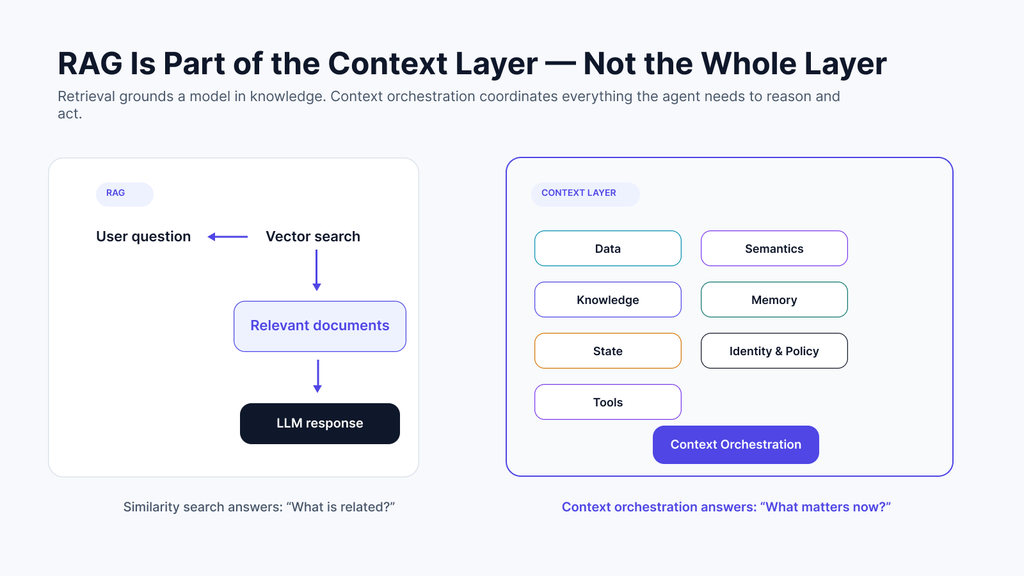
That architecture solved an important first-generation problem:
How do we ground a model in enterprise knowledge it was not trained on?
Agentic AI creates a broader problem:
How do we continuously assemble the right operating context for a system that reasons and acts?
Document retrieval remains useful.
But an agent might need the following:
- a policy from a document repository;
- current inventory from a database;
- customer status from a CRM;
- an approved metric from the semantic layer;
- recent conversation state;
- an earlier failed tool result;
- user authorization;
- a workflow deadline;
- the output of another agent.
No single vector database represents that context.
This is why the architecture is shifting from retrieval pipelines toward context orchestration.
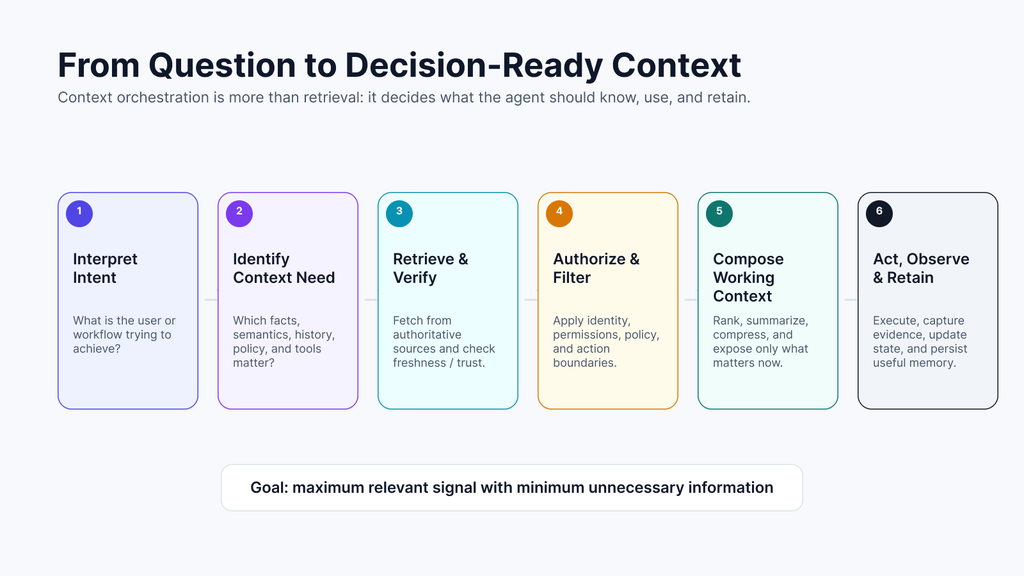
The context layer may decide the following:
- what information is needed;
- where it should come from;
- whether it is trustworthy;
- whether the agent is authorized to access it;
- how fresh it must be;
- how much of it should enter the model context;
- what should remain externally accessible;
- and what should be retained afterward.
This is a much richer architectural responsibility than similarity search.
5. More Context Is Not Better Context
A tempting response to context problems is to give models larger context windows and load more information.
That helps in some cases.
But it does not remove the need for architecture.
The problem is not merely how much information a model can read.
The problem is how much irrelevant, duplicated, stale, conflicting, or low-quality information it must process before finding what matters.
Anthropic describes context as a finite resource and recommends maximizing useful signal rather than simply maximizing token volume. Techniques such as compaction and structured note-taking can preserve useful state without carrying every raw interaction indefinitely.
Google has described a similar scaling issue in multi-agent systems: indiscriminately accumulating history and tool output increases cost and latency while potentially reducing signal quality.
This leads to an important principle for enterprise AI architecture:
The goal of the context layer is not maximum context. It is the maximum relevant signal with minimum unnecessary information.
That requires selection.
Compression.
Prioritization.
Freshness management.
Progressive retrieval.
And sometimes deliberate forgetting.
Context engineering is therefore as much about what not to send to the model as what to send.
6. A Practical Reference Model for the Enterprise Context Layer
Organizations do not necessarily need a product called a “context platform.”
They need a set of architectural capabilities that collectively provide context.
A practical reference model can be thought of as six layers.
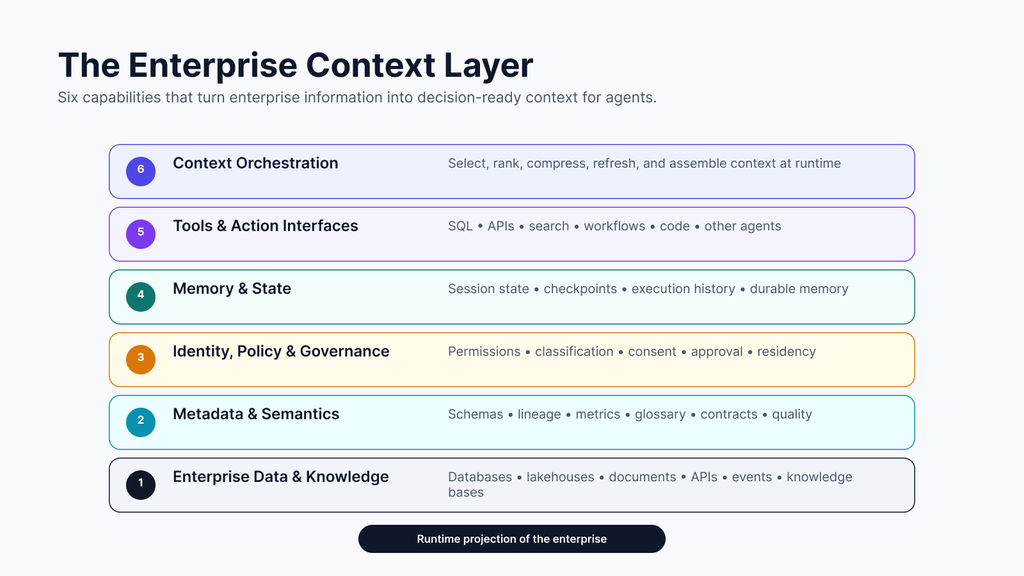
Layer 1: Enterprise Data and Knowledge
This is where source information lives:
- operational databases;
- lakehouses;
- warehouses;
- APIs;
- documents;
- messages;
- knowledge bases;
- event streams;
- external datasets.
The goal here remains trustworthy and accessible enterprise information.
Layer 2: Metadata and Semantics
This layer explains the information.
It includes:
- schemas;
- lineage;
- business glossary;
- semantic models;
- metric definitions;
- data contracts;
- quality indicators;
- ownership;
- domain mappings.
This layer answers:
What does this information mean, and can I trust it?
Layer 3: Identity, Policy, and Governance
This determines whether information or actions are appropriate.
It includes:
- user identity;
- agent identity;
- role-based permissions;
- classifications;
- policy rules;
- consent;
- data residency;
- approval requirements.
This layer answers:
May this agent use this information or perform this action in this situation?
Layer 4: Memory and State
This maintains continuity.
It may include:
- session state;
- workflow checkpoints;
- episodic memory;
- user preferences;
- approved organizational memory;
- previous decisions;
- execution history.
This layer answers:
What has happened before that matters now?
Layer 5: Tools and Action Interfaces
This exposes available capabilities:
- SQL;
- search;
- APIs;
- workflow engines;
- code execution;
- applications;
- other agents.
This layer answers:
What can the agent do next?
Layer 6: Context Orchestration
This is the dynamic layer.
At runtime, it combines the relevant information from the other layers into an appropriate working context.
It decides:
- what to retrieve;
- what to omit;
- what to summarize;
- what to refresh;
- what evidence to prioritize;
- which tools to expose;
- what state to retain;
- which policies apply.
This is where context engineering becomes platform engineering.
The final model context becomes a runtime projection of the enterprise, optimized for one particular decision.
That is a fundamentally different way of thinking about enterprise data architecture.
Building a Context Layer for Agentic AI
Enterprises do not need to rebuild their architecture from scratch.
Much of the required foundation probably already exists.
The challenge is connecting it deliberately.
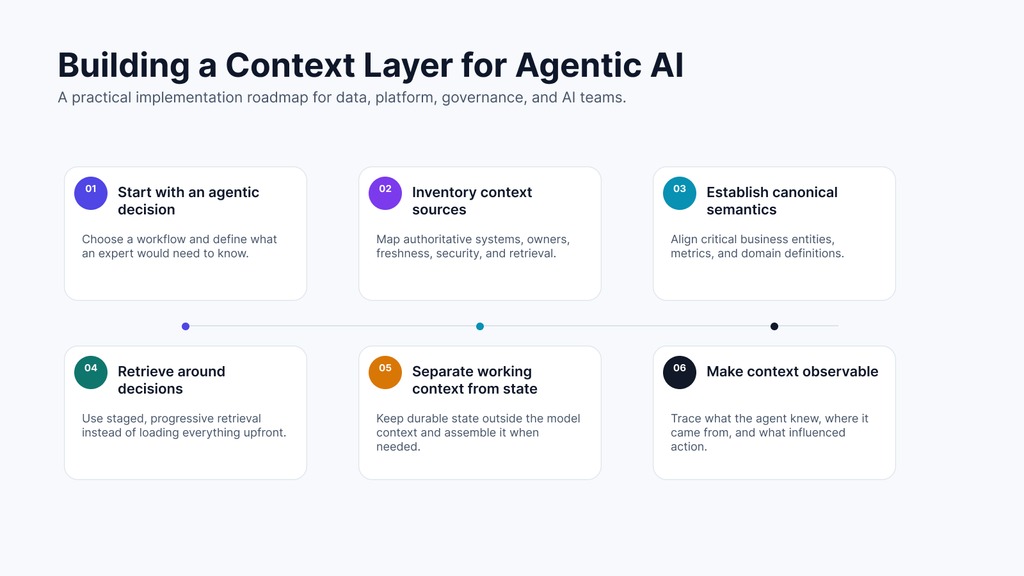
Step 1: Start With an Agentic Decision, Not a Technology
Choose a meaningful workflow.
For example:
Investigate failed data pipelines and recommend remediation.
Then ask:
What would an experienced engineer need to know before taking action?
Potential context might include:
- pipeline metadata;
- recent execution history;
- error logs;
- upstream/downstream lineage;
- ownership;
- recent deployments;
- similar incidents;
- runbooks;
- severity classifications;
- current infrastructure status;
- permitted remediation actions.
This exercise exposes the real context requirements.
Step 2: Inventory Context Sources
For every context type, identify:
- authoritative system;
- owner;
- refresh frequency;
- retrieval mechanism;
- security classification;
- quality expectations.
Do not immediately duplicate everything into a vector database.
Different contexts belong in different systems.
A structured operational state may be best retrieved directly.
Documentation may require semantic retrieval.
A workflow state may belong in a durable state store.
Business definitions may come from a semantic or metadata service.
Step 3: Establish Canonical Semantics
Agents amplify semantic inconsistency.
If Finance, Sales, and Product all define “active customer” differently, an AI agent cannot magically resolve the disagreement.
It will simply inherit it.
Prioritize high-value definitions:
- customers;
- products;
- revenue;
- orders;
- risks;
- policies;
- critical KPIs;
- domain entities.
AI readiness is increasingly dependent on semantic readiness.
Step 4: Design Context Retrieval Around Decisions
Avoid retrieving everything upfront.
Use staged retrieval.
An agent investigating a revenue issue might first retrieve metric definitions and high-level trends.
Only after detecting an anomaly should it retrieve regional details.
Only after identifying a region should it retrieve product-level data.
Context should become progressively more specific as reasoning progresses.
Step 5: Separate Working Context From Persistent State
The model context window should not become the system of record.
Keep durable information outside the model.
Maintain:
- workflow state;
- evidence;
- agent actions;
- important decisions;
- relevant memories.
Then construct the immediate model context from that state as required.
Modern agent architectures increasingly use exactly this separation so long-running sessions can retain recoverable information while selectively presenting only relevant portions to the model.
Step 6: Make Context Observable
For every important agent decision, teams should eventually be able to answer:
- What information did the agent receive?
- Where did it come from?
- When was it retrieved?
- What version was used?
- Which information was excluded?
- Which memory influenced the decision?
- Which tool was selected?
- Which policy was applied?
Without context observability, diagnosing agent failures becomes extremely difficult.
A model may appear to have reasoned incorrectly when the real issue was:
- stale context;
- missing metadata;
- incorrect retrieval;
- contradictory documents;
- poor tool descriptions;
- outdated memory;
- or an authorization filter.
Enterprise agent observability therefore needs to extend beyond prompts and responses.
It needs context lineage.
Common Failure Modes
As enterprises build agentic systems, several patterns are likely to cause problems.
Failure Mode 1: Turning the System Prompt Into a Database
Teams keep adding instructions, edge cases, policies, examples, definitions, and exceptions to one enormous system prompt.
Eventually, nobody knows which rule matters.
Better approach: externalize knowledge and retrieve context when it is relevant.
Failure Mode 2: Treating RAG as the Entire Architecture
Vector search becomes the answer to every context requirement.
But numerical state, permissions, workflow progress, tool definitions, real-time events, and structured business data often require different mechanisms.
Better approach: treat retrieval as one context provider within a broader orchestration layer.
Failure Mode 3: Saving Everything as Memory
Unlimited memory sounds attractive.
It also creates stale assumptions, conflicting instructions, privacy risks, and uncontrolled growth.
Better approach: classify memory by scope, purpose, authority, retention, and expiration.
Failure Mode 4: Ignoring Semantics
Giving agents access to thousands of tables without explaining business meaning rarely creates reliable enterprise intelligence.
Better approach: expose definitions, lineage, relationships, ownership, examples, and approved calculations.
Failure Mode 5: Exposing Every Tool
More tools create more ambiguity.
Modern agent engineering increasingly favors discovering or loading capabilities when needed rather than flooding the model with an enormous tool catalog.
Better approach: expose a minimal relevant capability set for the task.
Failure Mode 6: Separating Security From Context
Filtering only after the model has already received sensitive information is too late.
Better approach: authorization must influence context assembly before information enters the model.
Failure Mode 7: Having No Context Lineage
If an agent makes a poor decision and nobody can reconstruct what it knew at the time, governance becomes nearly impossible.
Better approach: log context provenance, versions, retrieval paths, state transitions, tool activity, and decisions.
The Emerging Opportunity for Data Leaders
Agentic AI is often presented as primarily an AI engineering challenge.
That interpretation is too narrow.
The quality of enterprise agents will increasingly depend on capabilities that data organizations already understand:
- metadata;
- semantics;
- quality;
- lineage;
- governance;
- contracts;
- identity;
- integration;
- observability;
- platform architecture.
The difference is that these capabilities now have to operate dynamically at inference and action time.
This creates an important opportunity for data leaders.
The conversation can move beyond the following:
“How do we make our data available to an LLM?”
toward:
“How do we make enterprise knowledge usable, contextual, governed, and decision-ready for autonomous systems?”
That is a much more strategic problem.
And solving it may determine whether enterprise agents remain impressive demonstrations or become dependable participants in real business processes.
Context May Become the Control Plane for Enterprise AI
The long-term significance of the context layer goes beyond better answers.
As agents become more autonomous, context determines behavior.
Change the available tools, and you change what the agent can do.
Change the permissions, and you change what the agent can see.
Change the memory, and you change what the agent believes it has learned.
Change the business definition, and you change how it interprets the world.
Change the workflow state, and you change what action is appropriate next.
In other words:
Context is increasingly becoming the control plane through which enterprises shape agent behavior.
That makes context architecture a first-class concern.
Future AI platforms may therefore be judged not only by which models they support, but by how effectively they can:
- discover context;
- govern context;
- compose context;
- persist context;
- refresh context;
- observe context;
- and provide the right context to the right agent at the right moment.
Models will continue to improve.
Context windows will continue to grow.
Agent frameworks will continue to evolve.
But enterprise reality will remain distributed across databases, documents, APIs, workflows, people, policies, historical decisions, and constantly changing operational state.
The organizations that can turn that fragmented reality into high-quality runtime context will have a significant advantage.
From AI-Ready Data to Agent-Ready Context
The first phase of enterprise GenAI was largely about giving models access to proprietary information.
The next phase is about enabling agents to operate reliably inside the enterprise.
That requires a broader foundation.
A trustworthy agent needs more than intelligence.
It needs:
the right data.
the right meaning.
the right history.
the right permissions.
the right capabilities.
the right information at the right moment.
Collectively, that is context.
So the architecture question for data and AI leaders is changing.
It is no longer only the following:
Do we have an AI-ready data platform?
Increasingly, it will be:
Do we have an architecture capable of creating trusted context for agents?
Because in an agentic enterprise, data remains the foundation.
But context becomes the layer that makes the data actionable.
And that may make context the next critical data layer for AI.
Frequently Asked Questions
What is a context layer in agentic AI?
A context layer is the set of architectural capabilities used to provide an AI agent with the information it needs for a particular decision or action. It can combine enterprise data, business semantics, retrieved knowledge, workflow state, memory, identity, policies, tool definitions, and runtime signals.
Unlike a traditional data layer, the context layer is highly dynamic. Its purpose is to determine what information matters now rather than simply make all available information accessible.
How is context engineering different from prompt engineering?
Prompt engineering primarily focuses on how instructions are written for a model.
Context engineering is broader. It determines what information, tools, examples, history, state, memories, and constraints should be available to the model at each stage of execution.
For simple GenAI applications, prompts may dominate the design.
For long-running agents interacting with multiple systems, managing context becomes an architectural problem.
Is RAG the same as context engineering?
No.
Retrieval-augmented generation is an important technique for retrieving relevant knowledge, especially documents and other unstructured information.
Context engineering also includes structured enterprise data, semantic definitions, tool availability, agent state, memory, authorization, workflow information, real-time signals, and decisions about what information should or should not enter the model’s working context.
RAG is therefore a component of a context strategy, not the complete strategy.
Does a larger context window eliminate the need for a context layer?
No.
Larger context windows allow models to process more information, but enterprises still need to decide which information is relevant, current, authoritative, permitted, and useful.
Loading unnecessary information can also increase cost and latency while introducing conflicting or distracting signals.
The architectural objective should therefore be better context, not merely more context.
Who should own the enterprise context layer?
No single function is likely to own it completely.
AI engineering may own agent orchestration, while data teams manage structured information and semantics, platform teams provide integration capabilities, security teams define access controls, and governance teams establish policies and accountability.
The context layer should therefore be treated as a cross-functional platform capability with clearly defined ownership boundaries.
Closing Thought
For decades, enterprise architecture has asked how information should be stored, integrated, transformed, governed, and consumed.
Agentic AI adds one more question:
How should the enterprise assemble what an intelligent system needs to know before it decides what to do?
That question is likely to define the next generation of data and AI platforms.
Data makes intelligence possible. Context makes intelligence useful.
Continue Exploring
Explore more perspectives in the Data Foundations for AI, Practical Data Architecture, and From Data to AI-Ready series as we examine how enterprise data platforms must evolve for AI agents, data products, governance, semantics, and autonomous decision-making.