
Where AI fits across the modern data lifecycle—and why context, validation, and engineering judgment matter more than simply generating SQL.
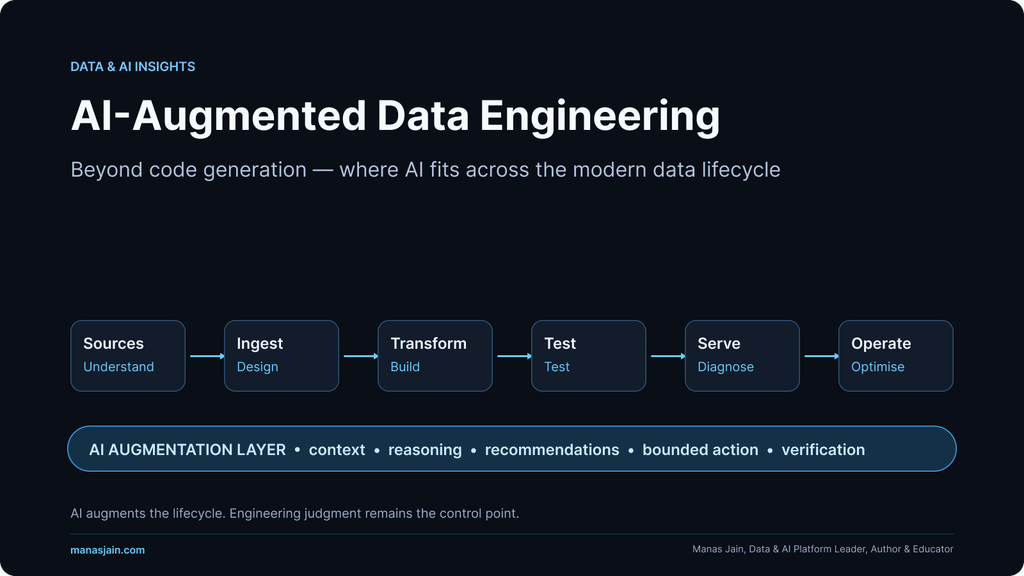
AI-Augmented Data Engineering is often reduced to one capability: asking AI to write SQL.
AI can write SQL surprisingly well. It can generate a transformation, explain a Spark function, convert one SQL dialect into another, and remove a surprising amount of repetitive work.
That is useful.
But it may also be one of the least interesting ways AI will change Data Engineering.
The more interesting shift starts when AI understands enough of the surrounding engineering context to help with the problem itself.
Why did this pipeline fail?
What changed between yesterday’s successful run and today’s failure?
Which downstream datasets could be affected if I modify this transformation?
Why has runtime doubled when data volume increased by only 15%?
Those are not simply code-generation questions.
They are engineering questions.
And that is where AI-Augmented Data Engineering becomes much more interesting.
What AI-Augmented Data Engineering Actually Means
A useful way to think about AI-Augmented Data Engineering is not as the replacement of an engineer, but as the expansion of what an engineer can understand and do within the same workflow.
Traditional engineering tools wait for instructions.
An orchestrator runs a predefined workflow. A monitoring rule evaluates a predefined threshold. A compiler validates code against known rules. An IDE provides autocomplete based on syntax and context.
AI introduces another capability: it can interpret less structured information, connect pieces of context, propose an approach, and sometimes perform a sequence of actions toward an engineering objective.
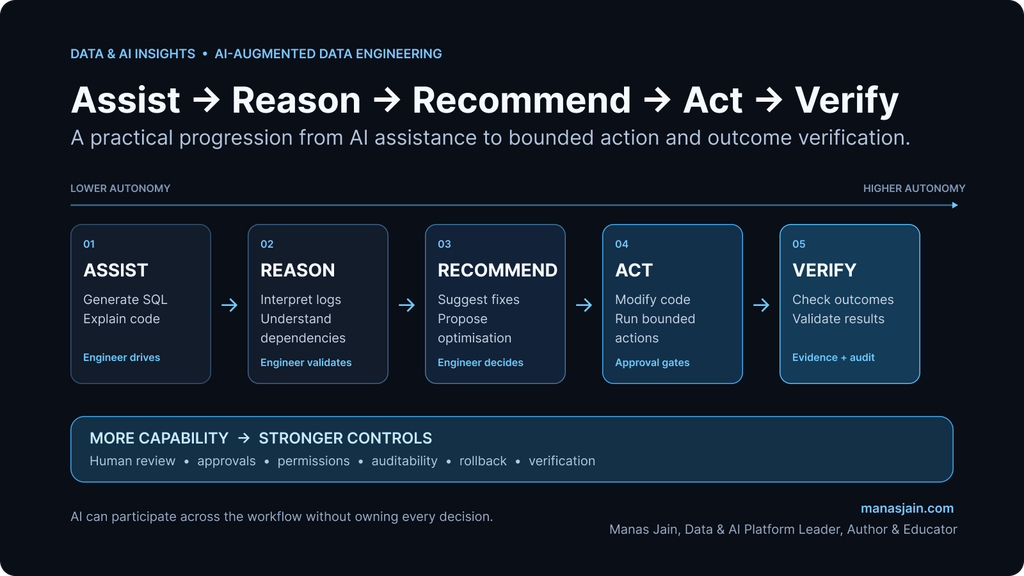
We can think about that progression as:
Assist → Reason → Recommend → Act → Verify
At the first level, AI helps write or explain code.
At the next level, it starts interpreting the system around the code.
Then it can recommend what should change.
With appropriate permissions, it may perform some of those actions.
And, importantly, it should also help determine whether the action produced the intended result.
I would not treat these stages as a maturity ladder where every organisation should automatically pursue maximum autonomy. In many production environments, stopping at Recommend with a human approving Act may be exactly the right design.
The objective is not autonomy for its own sake.
The objective is better engineering.
Why this conversation is becoming more relevant
We can already see engineering assistants moving beyond isolated code completion.
Databricks’ Genie Code in Agent mode, for example, can plan pipeline work, search relevant data assets, edit multiple pipeline files, execute pipeline updates, inspect outputs, and iterate on errors. Importantly, the workflow includes user approvals before consequential actions.
Microsoft Fabric’s Copilot for Data Engineering similarly uses more than the text of a prompt. Within notebooks, it can use context such as the attached lakehouse, available schemas and tables, existing notebook code, runtime state, and recent execution telemetry. It can generate and refactor across a workflow, diagnose failures, and propose fixes that can be reviewed before being applied.
This does not mean the problem is solved.
In August 2026, Snowflake published data-eng-bench, a benchmark designed specifically around repository-level data-engineering tasks using a live dbt project and enterprise-scale warehouse. One of the motivations was that general-purpose coding agents can struggle when the task requires understanding business logic, navigating a large data environment, and handling production-style edge cases.
That distinction matters.
Being good at generating Python or SQL is not the same as being good at Data Engineering.
Production Data Engineering depends on context.
Imagine a simple pipeline change
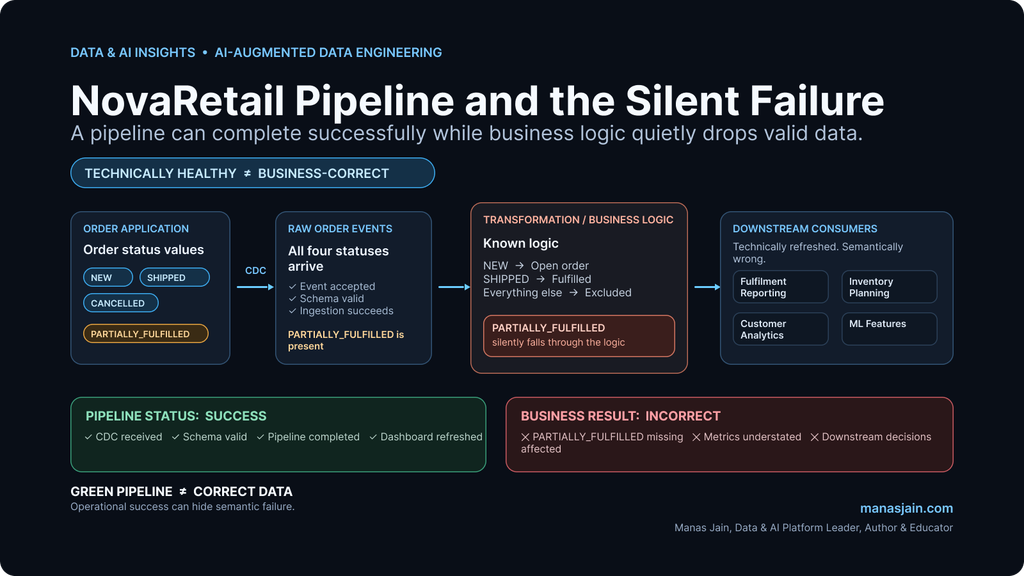
Consider a fictional retailer, NovaRetail.
Order changes arrive continuously from an operational application through Change Data Capture (CDC). The data passes through ingestion and transformation layers before feeding several downstream products: fulfilment reporting, inventory planning, customer analytics, and a machine-learning feature pipeline.
The source team releases a change.
Previously, an order had these fulfilment statuses:
NEW
SHIPPED
CANCELLED
The application now introduces:
PARTIALLY_FULFILLED
Nothing crashes.
The event arrives successfully. The schema accepts the value. The ingestion pipeline runs. The transformations complete. The dashboard refreshes.
From an infrastructure perspective, everything is green.
But one transformation contains business logic that effectively says:
NEW means open order.
SHIPPED means fulfilled order.
Everything else is excluded.
The new status is therefore silently dropped from an important metric.
This is the sort of problem that reveals the difference between code assistance and engineering augmentation.
Understanding before building
Suppose an engineer unfamiliar with the NovaRetail pipeline receives the issue.
Traditionally, a significant part of the investigation may involve finding the right repository, identifying the pipeline, reading transformations, understanding table relationships, checking orchestration history, examining recent commits, and tracing which outputs feed which consumers.
An AI assistant can already reduce some of this cognitive overhead.
Instead of asking only:
Explain this SQL.
the engineer could eventually ask:
Explain how fulfilment status moves from the source order event to the inventory-planning dataset, including the transformations that modify or filter it.
That requires much more context.
The AI needs access to relevant code, schemas, dependencies, metadata, execution information, and ideally some understanding of the business meaning behind the fields.
The code is only one piece of the puzzle.
This is an important shift because a surprising amount of Data Engineering work is not typing code. It is understanding systems that already exist.
Designing a change
Once the issue is understood, the engineer needs to decide what should change.
Should PARTIALLY_FULFILLED count as an open order?
Should part of its quantity count as fulfilled?
Does inventory planning use the same definition as customer analytics?
Do downstream consumers expect the existing calculation?
Should historical data be recomputed?
These are not questions an AI assistant should answer simply by finding the nearest piece of code and modifying it.
Some require technical context.
Others require business context.
Some require a human decision.
This is why I am cautious about framing AI-assisted engineering simply as:
Prompt → Code → Production
A more realistic workflow looks something like:
Intent → Context → Proposal → Implementation → Validation → Approval → Execution → Verification
AI may participate in almost every stage.
But participation does not imply ownership of every decision.
Building becomes faster—but that creates another problem
Code generation is still valuable.
Once the expected behaviour is clear, AI can generate or modify transformations, create tests, produce documentation, refactor repetitive logic, or translate requirements into SQL, Python, Spark, or another implementation language.
This can remove a considerable amount of routine work.
But faster code generation creates an uncomfortable side effect.
We can create bad engineering faster too.
If every engineer asks an assistant to solve a problem independently, a platform can quickly accumulate duplicated transformations, inconsistent naming, unnecessary abstractions, different implementation patterns, and code that works locally but does not fit the broader architecture.
The question therefore moves from:
Can AI generate working code?
to:
Can AI generate code that conforms to how this engineering organisation wants systems to be built?
That requires standards and context.
The better the assistant becomes at generating code, the more important those become.
This is closely related to a broader platform principle I have written about before: data teams should build reusable capabilities rather than repeatedly solving the same pipeline problem in isolation.
Testing must go beyond “the code runs”
Return to our NovaRetail example.
Suppose AI updates the transformation so that PARTIALLY_FULFILLED is no longer dropped.
The code compiles.
The pipeline succeeds.
Is the problem solved?
Not necessarily.
The engineer may need to validate row counts, totals, reconciliation results, expected order quantities, downstream calculations, incremental-processing behaviour, and perhaps historical compatibility.
This illustrates another principle that I think will become important:
AI-generated implementation should increasingly be paired with AI-assisted verification.
The same assistant that proposes a change could help identify what needs to be tested.
It might compare results before and after the modification.
It might flag an unexpected change in record volume.
It might detect that one downstream aggregation changed substantially while other expected outputs did not.
None of this eliminates deterministic tests or established Data Quality controls. AI should not become an excuse to replace reliable engineering checks with probabilistic judgment.
The interesting opportunity is using AI to make those controls easier to understand, create, investigate, and extend.
Troubleshooting may be where AI becomes genuinely valuable
Data engineers spend a lot of time diagnosing failures.
And production incidents rarely arrive as beautifully isolated coding exercises.
A Spark job fails after running successfully for six months.
A pipeline that normally takes 18 minutes suddenly takes 54.
A source schema changes.
An API begins returning an optional field differently.
A CDC stream contains out-of-order events.
A job succeeds but produces dramatically fewer records.
A freshness target is missed because an upstream process was delayed.
The first question during an incident is rarely:
Can someone write some code?
It is:
What happened?
An AI assistant with access to execution history, logs, recent code changes, schemas, dependencies, metrics, and previous incidents could potentially reduce the time required to form a useful hypothesis.
It might notice that a deployment occurred shortly before the failure.
It might correlate a runtime increase with a changed join strategy.
It might identify that a schema modification coincided with a sudden drop in output volume.
It might explain a cryptic infrastructure error in the context of the pipeline that produced it.
The engineer still needs to judge whether the explanation makes sense.
But reducing the search space from fifty possibilities to three plausible ones is already valuable.
Operations introduces a harder question
Eventually we reach the part of the lifecycle where the conversation becomes more sensitive.
Should AI only explain a problem?
Should it recommend a fix?
Should it prepare the change?
Should it execute the change?
Should it restart the pipeline?
Should it roll back a deployment?
Should it modify production configuration?
Technically, many of these actions will become possible.
Architecturally, that is not enough.
The system must also understand permissions, blast radius, approval requirements, auditability, rollback behaviour, and what should happen when its reasoning is wrong.
I would be comfortable giving an engineering assistant much more freedom in a development environment than in a production environment containing regulated or business-critical data.
And even within production, not all actions carry the same risk.
Re-running an idempotent transformation may be very different from deleting a table, changing an access policy, or triggering a full historical reload.
This is why human oversight is not merely a temporary limitation until AI becomes “better”.
In many systems, human judgment is part of the control architecture.
What actually makes a data-engineering assistant useful?
The model matters.
But I suspect the surrounding engineering context will matter just as much.
This is also why I have argued that a data platform is not simply a technology project. The value comes from the capabilities, standards, context, and operating model around the technology—not from assembling more tools.
An assistant that sees only my prompt can help me write SQL.
An assistant that understands the relevant schema can write better SQL.
Give it the repository and it can understand existing transformation patterns.
Give it dependencies and lineage and it can reason about impact.
Give it execution history and it can investigate behaviour over time.
Give it engineering standards and it can propose changes that better match the platform.
Give it controlled tools and permissions and it can perform bounded actions.
Give it validation signals, and it can check whether those actions worked.
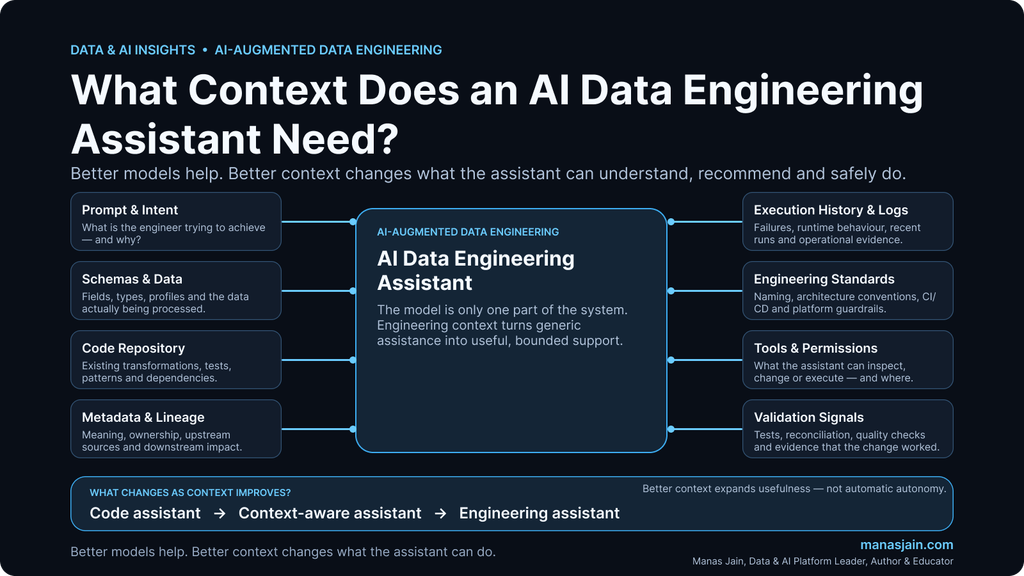
This is where several topics that Data Engineering teams already care about—metadata, lineage, quality expectations, observability, ownership, documentation, and governance—start gaining another consumer.
Historically, we designed many of these capabilities primarily for humans.
Increasingly, AI systems will need them too.
That deserves a deeper discussion of its own.
The engineer’s role does not disappear
Whenever AI and engineering appear in the same sentence, the conversation quickly becomes one about jobs.
I think that misses the more immediate change.
The unit of engineering work is shifting.
If an engineer spends less time writing repetitive transformation code, that does not make architecture decisions disappear.
Someone still has to decide what the data means.
Someone needs to recognise that two systems use the word “customer” differently.
Someone needs to understand whether a recomputation is safe.
Someone needs to decide how much autonomy an AI assistant should receive.
Someone needs to know when an apparently elegant solution creates a serious operational problem six months later.
And someone needs to recognise when the AI is confidently wrong.
The strongest data engineers in an AI-augmented environment may therefore spend relatively more time on intent, context, architecture, validation, and judgment.
Not because coding becomes irrelevant.
Because producing code becomes easier while deciding what should be built and whether it is correct remains difficult.
AI-Augmented Data Engineering Across the Lifecycle
I would therefore define AI-Augmented Data Engineering quite broadly.
It is the use of AI across the engineering lifecycle to help people understand systems, design changes, create implementations, test behaviour, investigate problems, optimise workloads, and operate data platforms—within appropriate engineering and organisational controls.
Sometimes that means autocomplete.
Sometimes it means explaining a pipeline.
Sometimes it means diagnosing an incident.
Sometimes it may mean an AI agent performing a bounded sequence of actions.
The right level will depend on the problem, the environment, and the consequences of being wrong.
That nuance matters.
There is little value in turning a deterministic three-step process into an AI agent merely because we can.
Equally, there is little reason for an engineer to spend an hour manually correlating logs, lineage, runtime metrics, and recent commits if an assistant can help assemble that context in minutes.
The goal is not to put AI everywhere.
It is to identify where intelligence genuinely improves the engineering workflow.
The more interesting question
The first wave of AI developer tools made it easier to write code.
That is useful, and it will continue improving.
But Data Engineering has never been primarily a typing problem.
It is a context problem.
A dependency problem.
A reliability problem.
A semantics problem.
An operating problem.
And very often, a judgment problem.
The next generation of engineering assistants will become interesting when they can help with those problems—not just generate another SELECT statement.
That also raises a harder challenge.
If we want AI to understand our data platforms well enough to help engineer them, what context do we need to give it, what actions should we allow it to take, and how do we know when to trust the result?
Those are the questions I want to explore next.